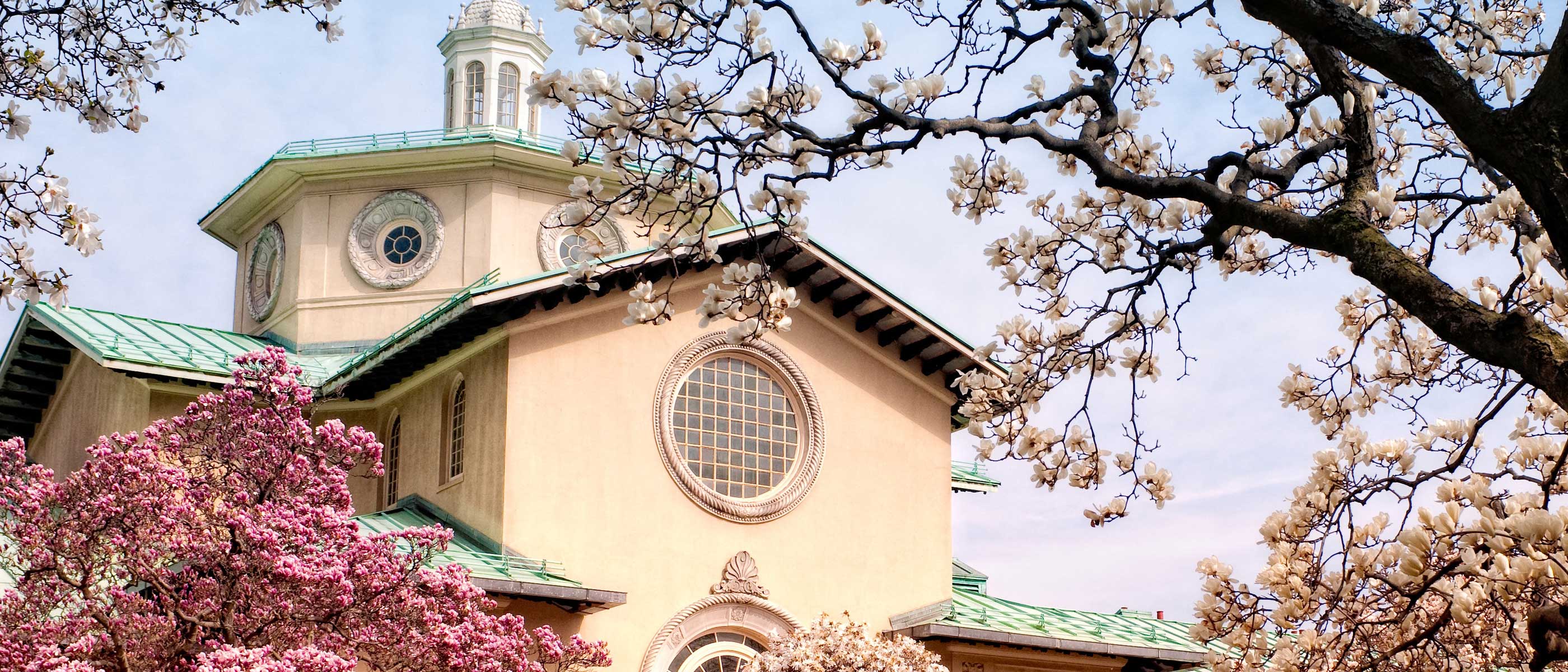
Magnolias, cherry blossoms, lilacs and more dot the Garden in early spring. Here are some of the highlights. Plan Your Visit Magnolia Plaza and Daffodil Hill: Spring’s Favorite Flowers The pink, white, and yellow blossoms of Magnolia Plaza are spectacular in the spring. Some trees are also living pieces of…
Krissie Nagy teaches kokedama classes at Brooklyn Botanic Garden has been making and selling her whimsical kokedama at the Brooklyn Flea since 2013. She is also the owner of BK Bumpkin , an ecological garden design/build firm based in Brooklyn. When Krissie isn’t building a garden or making a moss…
Winter reveals the architecture of natural forms and pops of color in a contemplative landscape. Or, transport yourself to a warm ecosystem in one of the Garden’s conservatories. Plan Your Visit Aquatic House and Orchid Collection: Another, Warmer, World Step indoors to the lush environment of the glass-enclosed Aquatic House,…
Edmund C. Snodgrass is a horticulturist and fifth-generation farmer on Emory Knoll Farms, a 135-acre farm in Street, Maryland. He is the founding partner of Green Roof Plants, the only commercial nursery in the U.S. specializing in growing plants for green roofs, and has consulted on projects around the country…
Sage Reynolds is an artist and designer. He runs the Four Hands Design Studio, which he founded in 1977 with his partner, Colman Rutkin, in New York. He has been growing ceropegias and other succulent plants for more than 30 years. As a hobbyist, he has also hybridized azaleas, lilies,…
Judging by the number of proposals that have happened on the grounds, Brooklyn Botanic Garden just might be one of the city’s most romantic spots. Plan Your Visit Cranford Rose Garden: Fragrant roses, lovely wildflowers, and classic sculptures Maybe it’s a cliché, but there really is nothing more romantic than…
Eric Au is manager of Youth Programs at Brooklyn Botanic Garden.
Join an accessible birding tour at the Garden led by educator Alexandra Wang (Avian Alex), M.S. Ed. This tour will introduce participants of all abilities to the art of birding (an inclusive term for birdwatching!).
The tour will follow accessible routes and include verbal description, augmentative and alternative communication (AAC) pamphlets, Braille pamphlets, large print, plush birds, and other touch objects.
The program is fully accessible, and wheelchairs are available on a first-come, first-served basis at the entrance. Personal care attendants enter for free and sighted guide assistance is available upon request.
If you have questions, additional accommodation requests, or need help with registration, email [email protected].
About Your Tour Guide
Alexandra Wang has an M.S.Ed. in Guidance and School Counseling from Hunter College (CUNY). Her goal is to connect birders of all abilities and disabilities to nature. She has given birding tours and events for NYC Bird Alliance, Fort Tryon Park Conservancy, Birding Bob, the Met Cloisters, PossABILITIES Club Alumni Association, and Wave Hill. She has also given birding tours for public and private schools, summer camps, senior citizen advocacy groups, and many other social justice groups.
Registration Form
Thank you for your interest in a verbal description tour at Brooklyn Botanic Garden. Please register by filling out the form below. If you have questions, additional accommodation requests, or need help with registering, email [email protected].
Brooklyn Botanic Garden is recruiting for the 2027 Garden Apprentice Program (GAP). Please join us for an information session to hear more about this urban agriculture and environmental education program for students in grades 9–11.
At the info session, you’ll meet current apprentices and see apprentices working in their placements. We’ll walk you through the application process, describe the program tiers in detail, and answer your questions. A nine-month commitment is required, March through November, and apprentices earn increasing levels of compensation as well as community service hours. Check out bbg.org/gap for more information, photos, frequently asked questions, and applications. Applications are available on this page.
Registration for the info session is required—use the form below. Invite friends and classmates—we look forward to meeting you!
Information Session: Saturday, October 17, 2026 | 11 a.m.–1 p.m.
Join us at the Garden to hear all about this urban agriculture and environmental education program for students in grades 9–11.
The Garden Apprentice Program (GAP) at Brooklyn Botanic Garden is a great way for teens to learn about urban agriculture and the environment while working in one of the most exciting public gardens in the world! Apprentices can work their way up the four-tier program.
If you enjoy getting your hands dirty and want to work with other teens, GAP may be for you.
Apprentices make a nine-month commitment to GAP, from March to November. Programming takes place once or twice a week during the spring and fall sessions, and four days a week in the summer. See the 2027 calendar and tier descriptions below for more information. Please reach out to [email protected] with any questions about the Garden Apprentice Program.
Develop job skills, including teamwork, communication, and leadership.
Earn a monetary reimbursement at the end of the apprenticeship.
Tier 1
Open to students in 9th grade
Tier 1 apprentices build skills in urban farming while learning to become effective environmental educators. They help facilitate programs for the Children’s Garden, where, guided by an adult instructor and a Tier 4 apprentice, they garden, cook with fresh ingredients, craft, and explore nature with children aged 4-12.
Reimbursement: $600
Tier 2
Open to students in 10th grade or to those who have successfully completed Tier 1
Tier 2 apprentices work both behind the scenes and with the public at Brooklyn Botanic Garden. Apprentices learn about ornamental garden design, teach visitors about botany in the Discovery Garden, and conduct science experiments.
Reimbursement: $700
Tier 3
Open to students in 11th grade or to those who have successfully completed Tier 2
Tier 3 apprentices work in teams to research, design, and create their own GAP carts, educational mobile exhibits that they present on the Garden grounds. Tier 3 apprentices practice public-speaking and teaching skills as they engage with Garden visitors from all over the world.
Tier 3 apprentices serve as role models for other apprentices.
Tier 3 apprentices who are rising seniors participate in college preparation sessions as they navigate the college application process.
Reimbursement: $800
Tier 4
Open to students who have successfully completed Tier 3
Tier 4 apprentices hone the skills they need to become effective environmental educators. With the mentorship of an adult instructor, Tier 4 apprentices help facilitate programs in the Children’s Garden, where, guided by an adult instructor, they garden, cook with fresh ingredients, craft, and explore nature with children aged 4–12. Tier 4 apprentices mentor new Tier 1 apprentices as they learn to navigate this new space and responsibility. Tier 4 apprentices also function as assistant teachers, providing their instructor with suggestions for activities, garden planning help, and more.
Tier 4 apprentices receive leadership training and serve as role leaders for other apprentices.
Tier 4 apprentices are onboarded as BBG staff, must be legally authorized to work in the U.S., and earn minimum wage.
1. How do I apply to GAP?
You can start an online application by clicking the “Apply” button above. By making an account, you can save your progress and make edits later. If you submit your application materials before December 4, 2026, you will be invited for an interview.
2. How does GAP decide who is accepted into the program?
The staff panel reviews the applications and considers the applicants’ short-answer responses and their references, as well as how the applicants represent themselves at the group interview. We are looking for commitment and genuine interest in learning at BBG, among other qualities. GAP aims to create a community that reflects the cultural, socioeconomic, and racial diversity of New York City. Past performance in the Garden Apprentice Program is also taken into consideration for returning applicants.
3. Do I get paid? When?
Apprentices who successfully complete Tiers 1–3 are given a one-time nontaxable reimbursement upon completion of the program in November. Apprentices in Tiers 1–3 are not employees, and there are no fees to participate. The allotment for each tier aims to reimburse apprentices for personal expenses accrued while participating in GAP. This includes sun/insect protection, shoes, outdoor clothing and gear, cellular fees to communicate with staff, lunch money, transportation, and some program materials.
Tier 1: $600
Tier 2: $700
Tier 3: $800
Apprentices who complete the program year with perfect attendance, as defined by the GAP handbook, will receive an additional reimbursement of $75
Tier 4 apprentices are considered part-time BBG staff and must be eligible to work in accordance with the NYC Department of Labor. Additionally, Tier 4 apprentices will receive an hourly wage of $17 per hour based on the applicable minimum wage set by the NYC Department of Labor.
4. What is the time commitment for an apprentice?
Apprentices typically work an average of 4–6 hours per week during the spring and fall and 20–25 hours per week during the summer. Over the course of the year, our apprentices spend approximately 190–220 hours at the Garden. All apprentices have mandatory training on three full Saturdays in March. Meetings, trainings, and special events will be added periodically to the calendar.
While many apprentices participate in sports, clubs, college prep, and other extracurricular activities, we do ask that serious applicants prioritize GAP, after academics. We help apprentices develop the time-management skills needed to juggle multiple responsibilities and are generally flexible regarding occasional conflicts, provided the apprentice communicates with supervisors in advance.
5. What are the dates for the 2027 program?
GAP runs from March through November 2027, with a one-day orientation in February. Please see the 2027 GAP Calendar for details.
6. Can I participate in only parts of GAP?
No. We ask apprentices to make a full commitment to the program, March–November. If you are looking for a summer internship only, this is not the place for you!
7. What if I want to go on vacation during the summer?
Please schedule family vacations and other activities outside the program dates.
8. If I participated in the Children’s Garden programs (Seeds, City Farmers, Junior Botanists, etc.), do I automatically get into GAP?
No, we do not automatically accept anyone into the program—all students must submit a full application and be interviewed. We have many apprentices who have participated in other BBG programs, and we encourage all former program participants to apply.
9. I am in the 12th grade now—can I apply to be an apprentice?
Unfortunately, students currently in the 12th grade are not eligible to apply for GAP. The only 12th graders in the program are returning Tier 4 apprentices. (Tier 4 is not open to new applicants.)
10. Do I have to pay to participate in the Garden Apprentice Program?
No, there is no fee to participate. Apprentices in Tier 1, Tier 2, and Tier 3 receive a reimbursement at the end of the program (see question 3).
11. Do I need to have gardening experience to be accepted as an apprentice?
No. We have some apprentices with years of experience in growing food and working with plants and many more apprentices who have never set foot in a garden. The apprenticeship is designed so that people with all knowledge levels have opportunities to learn and explore.
12. Do I need to disclose my immigration status to apply?
Regardless of your immigration status, you are encouraged to apply to GAP.
13. Do I have to start at Tier 1, or can I join the program at another tier level?
New applicants can apply to the Garden Apprentice Program Tier 1, Tier 2, or Tier 3. Tier 4 is only open to apprentices who have successfully completed Tier 3.
14. Can I skip a tier?
We encourage apprentices to participate in all tiers once they have joined GAP, as each tier offers apprentices unique learning opportunities. However, it is possible for an apprentice to skip a tier and reapply after taking a year off.
15. Do I have to reapply to the program every year?
Yes. Even if you were in the program previously, you must submit an application (with references) and participate in a group interview every year. You are not guaranteed a position in the next tier of the program just because you are a prior participant.
16. Can I apply for the Summer Youth Employment Program in the summer and still participate in GAP?
Due to scheduling constraints and other concerns, apprentices can not receive SYEP funding while participating in GAP for the summer.
17. Could participation in GAP count toward community service credit?
Absolutely! The hours you contribute to BBG as an apprentice are considered volunteer hours. These hours can be used toward community service requirements from your school. Even though apprentices receive reimbursement for time at the garden (see question 3), the hours contributed are still considered volunteer hours. Tier 4 apprentices are paid employees and their work hours do not count as community service.
18. Are OMNY cards provided for transportation to and from the Garden?
OMNY cards will not be provided for apprentices who receive an OMNY card through their school. If you are not given an OMNY card by your school, OMNY cards will be provided to Tier 1–3 apprentices to get to and from GAP programs.
19. Will the program consider applicants with disabilities or additional support needs?
Applicants with disabilities or additional support needs are given equal consideration. We review each individual’s application on a case-by-case basis and, in the case of applicants who may need significant support in order to participate fully in the program, we may follow up with the applicant and their family to ensure a good fit. Please contact us if you have questions or would like to discuss a particular student’s application.
20. How many apprentices are accepted into the program?
GAP accepts 12 to 14 apprentices per tier. In the past, we have received about three times that number of applications. Therefore, acceptance into the program is competitive but not impossible! Good luck!
More questions? Contact the GAP coordinators at 718-623-7252, 718-623-7328, or [email protected].
GAP Program 2027 Calendar
Dates listed below are mandatory. Additional optional shifts and special events may be added to the calendar later. Please contact the GAP Coordinators ASAP if you have scheduling conflicts or concerns: [email protected].
GAP Identity Workshop: Thursday, July 22, 2–4 p.m.
Iron Chef: Tuesday, August 3, 9 a.m.–1 p.m.
Summer Potluck Prep: Friday, August 13, 2–3:30 p.m.
End of Summer Potluck Celebration: Friday, August 13, 3:30–5:30 p.m. Families invited!
GAP Fall Programs 2027 (September–November)
Tier
Program
Date and time
TIER 1
Children’s Garden Choose Fridays or Saturdays.
Fridays 3–6 p.m., September 10, 17, 24; October 1, 8, 15, 22 OR Saturdays 9 a.m.–1 p.m., September 11, 18, 25; October 2, 9, 16, 23
TIER 2
Science Research or Discovery Garden
Science Research: Saturdays, 10:30 a.m.–1 p.m., September 11, 18, 25; October 2, 9, 16, 23 OR Discovery Garden: Saturdays, 10 a.m.–1 p.m., September 11, 18, 25; October 2, 9, 16, 23
TIER 3
Carts
Saturdays 10:30 a.m.–1 p.m., September 11, 18, 25; October 2, 9, 16, 23
TIER 4
Children’s Garden Choose Fridays or Saturdays.
Fridays 3–6 p.m., September 10, 17, 24; October 1, 8, 15, 22 OR Saturdays 9 a.m.–1 p.m., September 11, 18, 25; October 2, 9, 16, 23
ALL GAP
Horticulture Choose Wednesdays or Saturdays.
Wednesdays 4–6 p.m., September 8, 15, 22, 29; October 6, 13, 20 OR Saturdays 2–4 p.m., September 11, 18, 25; October 2, 9, 16, 23
ALL GAP
End of Season Special Events
GAP Closing Meeting: Saturday, October 30, 9 a.m.–3:30 p.m. GAP Graduation: Saturday, November 6, 12–3 p.m. Families invited!
Support
William C. Bullitt Foundation
Bulova Stetson Fund
The City Gardens Club of New York City
Constans Culver Foundation
The Pinkerton Foundation
Shop a curated and dazzling selection of plants for your home and garden. This year, shoppers can find native trees and shrubs fit for Brooklyn yards, unusual orchids, diverse tropicals and succulents, indoor and outdoor bulbs including uncommon varietals, and much more. Pot up your new purchase at Terrain while you check out pumpkins and new fall arrivals!
Brighten your home, stoop, and garden while supporting BBG—all proceeds benefit the Garden’s operations and programs. The Fall Plant Sale is presented by the BBG Auxiliary.
Garden admission is free for Fall Plant Sale shoppers. Purchased plant materials are not permitted in other areas of the Garden, so plan to exit through 990 Washington Avenue. Garden members get 10% off all purchases.
Get Tickets
{embed="includes/_inline_image" file="https://www.bbg.org/img/uploads/hero/_index_thumbnail_retina/plant_sale-MS-53253917553.jpg"} Photo by Michael Stewart.
Join the inner circle of Garden friends: the President’s Circle.
Your support at the President’s Circle level makes you a partner in a community of dedicated individuals sustaining Garden programs that have an impact around the corner and across the globe.
In appreciation and recognition of your philanthropic commitment to Brooklyn Botanic Garden, we are honored to offer you unique privileges and opportunities. Get to know the Garden intimately through special behind-the-scenes tours by its dedicated staff, private previews of public events, and exclusive evening events with cocktails.
For more information on becoming part of this special group, please call 718-623-7246 or email [email protected].
In appreciation of their generosity, President’s Circle members are afforded all the benefits of general members, plus unique access to the Garden. Highlights of President’s Circle benefits include:
Cherry Blossom Celebration
Join us for a tranquil, elegant evening of hanami, or flower viewing, with wine and curator talks under the exquisite canopy of Cherry Esplanade.
Cocktails & Exclusive Evenings in the Garden
Connect with other Garden friends and meet BBG’s curators
to learn about their work during intimate cocktail receptions
at the Garden and in the homes of BBG friends and trustees.
All BBG Member benefits, including:
Invitations to members’ events, including the Members’ Plant Sale Preview, Members’ Summer Hours, and Sunset Picnics
10% discount on BBG dining and retail
Discounts and advance notice for public programs and courses
BBG note cards
Library use and borrowing privileges
Privileges at nearly 400 botanic gardens across the country and beyond
Levels and Additional Benefits
Lilac $1,500
Lilac-Level Benefits:
Invitation to private previews, receptions, and other events specifically for the President’s Circle
Two Signature Plants selected by BBG horticulturists
Personally guided tour of BBG
Unlimited free general admission to BBG for you and your guests
Unlimited free parking during Garden public hours, members’ hours and ticketed events upon presentation of membership card
Recognition in BBG’s newsletter, Plants & Gardens
One complimentary Individual membership for a friend
$1,273 tax deductible
Wisteria $2,500
Wisteria-Level Benefits:
Invitation to private previews, receptions, and other events specifically for the President’s Circle
Two Signature Plants selected by BBG horticulturists
Personally guided tour of BBG
Unlimited free general admission to BBG for you and your guests
Unlimited free parking during Garden public hours, members’ hours and ticketed events upon presentation of membership card
One complimentary Dual membership for a friend
Recognition in BBG’s newsletter, Plants & Gardens
$2,249 tax deductible
Magnolia $5,000
Magnolia-Level Benefits:
Invitation to private previews, receptions, and other events specifically for the President’s Circle
Two Signature Plants selected by BBG horticulturists
Personally guided tour of BBG
Unlimited free general admission to BBG for you and your guests
Unlimited free parking during Garden public hours, members’ hours and ticketed events upon presentation of membership card
Recognition in BBG’s newsletter, Plants & Gardens
One complimentary Friends & Family membership for a friend
Personal tour of BBG by senior Horticulture staff
$4,725 tax deductible
Oak $10,000
Oak-Level Benefits:
Invitation to private previews, receptions, and other events specifically for the President’s Circle
Two Signature Plants selected by BBG horticulturists
Personally guided tour of BBG
Unlimited free general admission to BBG for you and your guests
Unlimited free parking during Garden public hours, members’ hours and ticketed events upon presentation of membership card
Recognition in BBG’s newsletter, Plants & Gardens
One complimentary Contributor membership for a friend
Personal tour of BBG by senior Horticulture staff
Personal lunch and tour of Garden for two with BBG’s president
$9,553 tax deductible
Rose $25,000
Rose-Level Benefits:
Invitation to private previews, receptions, and other events specifically for the President’s Circle
Two Signature Plants selected by BBG horticulturists
Personally guided tour of BBG
Unlimited free general admission to BBG for you and your guests
Unlimited free parking during Garden public hours, members’ hours and ticketed events upon presentation of membership card
Recognition in BBG’s newsletter, Plants & Gardens
One complimentary Supporter membership for a friend
Personal tour of BBG by senior Horticulture staff
Personal lunch and tour of Garden for two with BBG’s president
Opportunity to host a private event during select hours for up to 25 guests in one of BBG’s gardens (catering costs apply)
$24,522 tax deductible
Chairman’s Circle
The distinguished members of the Chairman’s Circle form the Garden’s philanthropic leadership through their annual support of $50,000 or more. For more information, please call 718-623-7246 or email [email protected]
For more information on becoming part of this special group, please call 718-623-7246 or email [email protected].
Join a guided verbal description tour of the glittering winter spectacular at Lightscape featuring live verbal descriptions of the stunning light installations. The tour will begin at 4 p.m. and last approximately 1.5 hours, giving participants an opportunity to experience the magic of the Lightscape trail with fewer crowds.
The trail is fully accessible, and wheelchairs are available on a first-come, first-served basis at the entrance. Personal care attendants enter for free and sighted guide assistance is available upon request.
If you have questions about accessibility at Brooklyn Botanic Garden, please reach out to [email protected].
Registration Form
Thank you for your interest in a verbal description tour at Brooklyn Botanic Garden. Please register by filling out the form below. Please choose the date for which you have purchased your Lightscape tickets. If you have questions, additional accommodation requests, or need help with registering, email [email protected].
Support
Lead Sponsor, Lightscape
Project Green Reach (PGR) is Brooklyn Botanic Garden’s (BBG) outreach program for K–8 teachers and their classes from Brooklyn’s Title I schools. PGR works with two cohorts of teachers and their classes every school year (fall and spring). Every spring PGR also holds a school-garden-based program for fourth- and fifth-grade classes, Garden Lab, and every other winter, PGR holds an Alumni Workshop for teachers who have participated in PGR before.
PROJECT GREEN REACH
Project Green Reach (PGR) is BBG’s semester-long outreach program for teachers and their classes from K–8 Title I (public and nonpublic) schools in Brooklyn.
What Students Receive
Guided tour of the Garden in small groups (buses provided by BBG)
In-classroom hands-on, inquiry-based science lesson provided by BBG staff
Plant for each student to care for and observe
Opportunity for students to share their botanical knowledge through a project that benefits their school’s immediate community (school, senior center, firehouse, etc.)
What Teachers Receive
In-class modeling of an inquiry-based science lesson by BBG staff
Plant supplies and staff support for each class to complete a community project
How to Apply
Teachers must apply to PGR in pairs (two teachers/classes per school), with each teacher filling out their own application for their own class. The teachers do not have to teach the same grade level.
The fee for this program is $200 total for both classes.
The application period for the fall semester (October–January) is every September and for the spring semester (February–May) is December through early January.
Fall 2026 applications are closed. Check back in January to apply for our spring program.
PGR Curriculum Options
Bulbs (Fall Only)
The fast-growing paperwhite narcissus is the perfect subject for scientific observation and data collection. Students can see these bulbs bloom within six weeks of being planted. Find out with your class why bulbs grow so fast!
Flowers, Fruits & Seeds (Spring Only)
We all love plants for their beautiful flowers, but what do flowers do for the plant? How do fruits form and why do they hide seeds inside? Students will explore, dissect, and plant fast-growing bean seeds in order to observe a complete life cycle in the classroom.
Kitchen Botany
Do people eat plants? When you eat a carrot, what part of the plant are you eating? Students will observe, plant, and cultivate their own carrots as they answer these questions and learn about the different plant parts and their functions.
Desert Environments
The desert environment is both harsh and fascinating. Students will discover some amazing adaptations plants have that allow them to survive the arid conditions and extreme temperatures of this environment. In class, students will dissect and pot up a desert succulent.
Tropical Rainforests
The tropical rainforest is home to an incredible diversity of plants. We will examine tropical plants up close to discover their particular niches within the rainforest environment. In class, students will each plant their own terrarium with a tropical plant they propagate themselves. Themes of biodiversity, adaptation, and plant-animal interdependence are introduced.
GARDEN LAB
PGR’s Garden Lab is a spring-semester program that brings inquiry-based science learning to public and nonpublic Title I schools with access to an outdoor, raised-based garden. We work with two fourth- or fifth-grade classes and their teachers per school every spring. Teachers who have already participated in Project Green Reach may apply to Garden Lab!
What Garden Lab Offers
Two 3-hour professional development teacher workshops at BBG
Three 2-hour in-classroom and in-garden lessons at your school
One 1-hour guided tour of BBG
A plant for each student, as well as classroom and school garden plants
What Teachers Commit To
Facilitating additional in-class plant science observations and investigations
Tending the garden with their classes (watering, weeding) from March through June
Sharing lessons and activities with peer teachers at a BBG workshop
Planning, organizing, and leading a harvest-day salad fest with their classes
Teachers must apply for acceptance into Garden Lab. Two teachers and their classes must apply from each school; however, both teachers do not have to teach the same grade level (e.g., one fourth- and one fifth-grade class). The fee for this program is $200 total for both classes.
ALUMNI WORKSHOPS
PGR Alumni Workshops are open only to teachers who have already participated in Project Green Reach. These full-day professional development programs provide teachers with resources and materials to support a plant-inquiry unit. The PGR Teacher/Alumni Workshop is offered every other year.
SCIENCE STANDARDS CONNECTIONS
Project Green Reach and BBG’s classes for teachers and school groups support the Next Generation Science Standards that developed from the National Research Council’s 2012 Framework for K–12 Science Education. The framework calls for knowledge and practice to be intertwined so that students “actively engage in scientific and engineering practices and apply crosscutting concepts to deepen their understanding of the core ideas in these fields.” This approach aligns with BBG’s longstanding educational philosophy of learning by doing. Our educational programs are grounded in inquiry-based, hands-on experiences to encourage life-long learning about plants, science, and the environment.
Desert Environment (grades K–8) and Tropical Rainforest (grades K–8)
Kindergarten
LS1.C Organization for Matter & Energy Flow in Organisms
All animals need food in order to live and grow. They obtain their food from plants or from other animals. Plants need water & light to live and grow.
ESS2.D Weather and Climate
Weather is the combination of sunlight, wind, snow or rain, and temperature in a particular region at a particular time. People measure these conditions to describe and record the weather and to notice patterns over time.
ESS3.A Natural Resources
Living things need water, air, and resources from the land, and they live in places that have the things they need.
Grade 1
LS1.A Structure & Function
All organisms have external parts. Plants also have different parts (roots, stems, leaves, flowers, fruits) that help them survive and grow.
LS1.B Growth & Development of Organisms
Adult plants & animals can have young.
LS1.D Information Processing
Animals have body parts that capture and convey different kinds of information needed for growth and survival. Animals respond to these inputs with behaviors that help them survive. Plants also respond to some external inputs.
LS3.A Inheritance of Traits
Young animals are very much, but not exactly, like their parents. Plants also are very much, but not exactly, like their parents.
LS3.B Variation of Traits
Individuals of the same kind of plant or animal are recognizable as similar but can also vary in many ways.
Grade 2
LS2.A Interdependent Relationships in Ecosystems
Plants depend on water, light, and air to grow.
Animals depend on plants or other animals for food.
LS4.D Biodiversity & Humans
There are many different kinds of living things in any area, and they exist in different places on land and in water.
ESS2.B Plate Tectonics and Large-Scale System Interactions
Maps show where things are located. One can map the shapes and kinds of land and water in any area.
Grade 3
LS4.B Natural Selection
Sometimes the differences in characteristics between individuals of the same species provide advantages in surviving, finding males, and reproducing.
LS3.A Inheritance of Traits
Many characteristics of organisms are inherited from their parents.
Other characteristics result from individuals’ interactions with the environment, which can range from diet to learning.
Some characteristics result from the interactions of both inheritance and the effect of the environment.
LS3.B Variation of Traits
Different organisms vary in how they look and function because they have different inherited information.
The environment also affects the traits that an organism develops.
LS3.C Adaptation
For any particular environment, some kinds of organisms survive well, some survive less well, and some cannot survive at all.
ESS2.D Weather and Climate
Climate describes a range of an area’s typical weather conditions and the extent to which those conditions vary over years.
Grade 4
LS1.A Structure and Function
Plants and animals have both internal and external structures that serve various functions in growth, survival, behavior, and reproduction.
Grade 5
LS1.C Organization for Matter and Energy Flow in Organisms
Plants acquire their material for growth chiefly from air and water.
LS2.A Interdependent Relationships in Ecosystems
Organisms can survive only in environments in which their particular needs are met. A healthy ecosystem is one in which multiple species of different types are each able to meet their needs in a relatively stable web of life.
PS3.D Energy in Chemical Processes and Everyday Life
The energy released from food was once energy from the sun that was captured by plants in the chemical process that forms plant matter (from air and water).
Grades 6–8
LS1.B Growth & Development of Organisms
Genetic factors as well as local conditions affect the growth of the adult plant.
LS2.A Interdependent Relationships in Ecosystems
Organisms can survive only in environments in which their particular needs are met. A healthy ecosystem is one in which multiple species of different types are each able to meet their needs in a relatively stable web of life.
In any ecosystem, organisms and populations with similar requirements for food, water, oxygen, or other resources may compete with each other limited resources, access to which consequently constrains their growth & reproduction.
Growth of organisms & population increases are limited by access to resources.
LS4.B Natural Selection
Natural selection leads to the predominance of certain traits in a population, and the suppression of others.
Adaptation by natural selection acting over generations is one important process by which species change over time in response to changes in environmental conditions. Traits that support successful survival and reproduction in the next environment become more common; those that do not become less common. Thus, the distribution of traits in a population changes.
Kitchen Botany (grades K–8)
Kindergarten
LS1.C Organization for Matter & Energy Flow in Organisms
All animals need food in order to live and grow. They obtain their food from plants or from other animals. Plants need water & light to live and grow.
Grade 1
LS1.A Structure & Function
All organisms have external parts. Plants also have different parts (roots, stems, leaves, flowers, fruits) that help them survive and grow.
Grade 2
LS2.A Interdependent Relationships in Ecosystems
Plants depend on water, light, and air to grow.
Animals depend on plants or other animals for food.
Grade 3
LS3.A Inheritance of Traits
Many characteristics of organisms are inherited from their parents.
Grade 4
LS1.A Structure and Function
Plants and animals have both internal and external structures that serve various functions in growth, survival, behavior, and reproduction.
Grade 5
LS1.C Organization for Matter and Energy Flow in Organisms
Plants acquire their material for growth chiefly from air and water.
PS3.D Energy in Chemical Processes and Everyday Life
The energy released from food was once energy from the sun that was captured by plants in the chemical process that forms plant matter (from air and water).
Grades 6–8
LS1.B Growth & Development of Organisms
Organisms reproduce, either sexually, or asexually, and transfer their genetic information to their offspring.
Genetic factors as well as local conditions affect the growth of the adult plant.
LS1.C Organization for Matter and Energy Flow in Organisms
Plants, algae (including phytoplankton), and many microorganisms use the energy from light to make sugars (food) from carbon dioxide from the atmosphere and water through the process of photosynthesis, which also releases oxygen. These sugars can be used immediately or stored for growth for later use.
LS1.D Information Processing
Plants respond to stimuli such as gravity (geotropism) and light (phototropism).
Bulbs (grades K–8) & Flowers, Fruits, and Seeds (grades K–8)
Kindergarten
LS1.C Organization for Matter & Energy Flow in Organisms
All animals need food in order to live & grow. They obtain their food from plants or from other animals. Plants need water & light to live and grow.
ESS3.A Natural Resources
Living things need water, air, & resources from the land, and they live in places that have the things they need.
Grade 1
LS1.A Structure & Function
All organisms have external parts. Plants also have different parts (roots, stems, leaves, flowers, fruits) that help them survive and grow.
LS1.B Growth & Development of Organisms
Adult plants and animals can have young.
LS3.A Inheritance of Traits
Young animals are very much, but not exactly, like their parents. Plants also are very much, but not exactly, like their parents.
LS3.B Variation of Traits
Individuals of the same kind of plant or animal are recognizable as similar but can also very in many ways.
Grade 2
LS2.A Interdependent Relationships in Ecosystems
Plants depend on water, light, and air to grow.
Plants depend on animals for pollination or to move their seeds around.
LS4.D Biodiversity & Humans
There are many different kinds of living things in any area, and they exist in different places on land and in water.
Grade 3
LS1.B Growth & Development of Organisms
Reproduction is essential to the continued existence of every kind of organism. Plants and animals have unique and diverse life cycles.
LS3.A Inheritance of Traits
Many characteristics of organisms are inherited from their parents.
LS3.B Variation of Traits
Different organisms vary in how they look and function because they have different inherited information.
LS4.B Natural Selection
Sometimes the differences in characteristics between individuals of the same species provide advantages in surviving, finding males, and reproducing.
Grade 4
LS1.A Structure and Function
Plants and animals have both internal and external structures that serve various functions in growth, survival, behavior, and reproduction.
Grade 5
LS1.C Organization for Matter and Energy Flow in Organisms
Plants acquire their material for growth chiefly from air and water.
PS3.D Energy in Chemical Processes and Everyday Life
The energy released from food was once energy from the sun that was captured by plants in the chemical process that forms plant matter (from air and water).
Grades 6–8
LS1.B Growth & Development of Organisms
Organisms reproduce, either sexually or asexually, and transfer their genetic information to their offspring.
Genetic factors as well as local conditions affect the growth of the adult plant.
LS1.C Organization for Matter and Energy Flow in Organisms
Plants, algae (including phytoplankton), and many microorganisms use the energy from light to make sugars (food) from carbon dioxide from the atmosphere and water through the process of photosynthesis, which also releases oxygen. These sugars can be used immediately or stored for growth for later use.
LS1.D Information Processing
Plants respond to stimuli such as gravity (geotropism) and light (phototropism).
Garden Lab (grades 4–5)
Grade 4
LS1.A Structure and Function
Plants and animals have both internal and external structures that serve various functions in growth, survival, behavior, and reproduction.
Grade 5
LS1.C Organization for Matter and Energy Flow in Organisms
Plants acquire their material for growth chiefly from air and water.
PS3.D Energy in Chemical Processes and Everyday Life
The energy released from food was once energy from the sun that was captured by plants in the chemical process that forms plant matter (from air and water).
Support
Major Supporter
Additional Support
William C. Bullitt Foundation
Green Charitable Foundation
Ronald J. Weiss and Catherine W. Weiss
Join us for a program of gardening activities designed for people living with dementia and memory loss and their care partners.
We’ll be turning over accessible, raised garden beds for the winter and prepping for next spring. Our experienced Garden Guides will take participants on a tour of the Children’s Garden and assist as we pull out annual plants, turn over the soil, and plant bulbs that will bloom in spring. This is a drop-in program: Participants are welcome to arrive anytime during the session, and step away or leave when they wish.
Garden entry and program participation is free, but space is limited and preregistration is required. More information about the program, including where to arrive, will be sent to registered participants ahead of the program.
This program is outdoors and will be canceled in inclement weather, which includes rain and temperatures above 85 degrees or below 50 degrees. Cancellation decisions are made no later than 24 hours before the program start time. If the program is canceled, BBG staff will contact registered participants.
Accessible seating is available for people with limited mobility. Please contact [email protected] with any accessibility-related questions.
Register
You may select any of the upcoming program dates. If you have questions, additional accommodation requests, or need help with registration, email [email protected]. If a message at the top of this page says that the program is full, you will be added to the waitlist.
Join us at Brooklyn Botanic Garden for programs designed for individuals with memory loss and their care partners. Enjoy conversation, refreshments, short guided tours, and movement and art-making activities facilitated by trained volunteers.
These programs are free, but space is limited, so registration is required. For more information and to register, contact us at [email protected].
In warmer weather, Memory Programs are held outdoors and in the Children’s Garden; in cooler weather, they are held inside the Education Greenhouses and Steinhardt Conservatory.
{embed="includes/photoset" photoset_entry_id="7933"}
Photos by Joanne D'Auria.
Memory Programs will be added as they are scheduled. Sign up below if you want to be alerted by email. To view all upcoming Access Programs, view our Event Calendar. For general information, see the Accessibility page.
Join us for an afternoon in the Garden. We’ll begin this program with a gentle, tai chi–inspired movement activity, followed by a stroll around Lily Pool Terrace. We’ll end with refreshments and an art-making activity inspired by the whimsical leaves and flowers featured in this year’s rococo-themed Annual Border.
Garden entry and program participation is free, but space is limited and preregistration is required. More information about the program, including where to arrive, will be sent to registered participants ahead of the program.
This program will be moved indoors in the case of inclement weather, which includes rain and temperatures above 85 degrees or below 50 degrees. Cancellation decisions are made no later than 24 hours before the program start time. If a program is canceled, BBG staff will contact registered participants.
Accessible seating is available for people with limited mobility. Please contact [email protected] with any accessibility-related questions.
Register
You may select any of the upcoming program dates. If you have questions, additional accommodation requests, or need help with registration, email [email protected]. If a message at the top of this page says that the program is full, you will be added to the waitlist.
After-School Professional Development Program “P” In‑Service Course/NYC Public Schools
What Did a Plant Ever Do for You?
3 “P” Credit Course*
Are you interested in learning about the fascinating world of plants? Explore the beautiful gardens and collections at Brooklyn Botanic Garden and gain an understanding of the value of plants in natural and human history. Through an inquiry-based approach, we will discover how plants are built, how they work, and how they interact with the living and nonliving components of the diverse environments they inhabit. Emphasis is placed on experiential, authentic learning that participants can readily bring back to their classrooms.
In-person classes run Monday–Friday, 8:30 a.m.–5 p.m. An additional 7.5 hours of asynchronous work will be assigned, beginning on August 9. Fees include curriculum materials, plants, potting supplies, and garden access.
Pre-K–12 Teachers
Fee: $262
Date: Hybrid course begins online on August 9, 2027. Five in-person sessions; August 16–20, 2027 at Brooklyn Botanic Garden.
*3 “P” credits available for an additional $125 fee through the After School Professional Development Program. You must register both for the class through BBG and for the credit through ASPDP.
Are you interested in developing a program tailored to support your staff’s professional goals or helping educators learn how to integrate plants and the beautiful collections of the Garden to support student learning?
Contact the Garden to explore the suggested workshop topics below or collaborate to create your own unique experience!
This course will address Danielson Criteria (2a, 3b, 3c), the Culturally Responsive-Sustaining Education framework, and the following aspects of the Next Generation Science and ELA Standards:
Next Generation Science Standards
Disciplinary Core Ideas:
LS1A Structure and Function LS2A: Interdependent Relationships in Ecosystems LS4C: Adaptation
Cross-Cutting Concepts:
Patterns Cause and Effect Structure and Function Stability and Change
Science and Engineering Practices:
Asking Questions and Defining Problems Developing and Using Models Planning and Carrying Out Investigations Obtaining, Evaluating, and Communicating Information
New York State Next Generation ELA Anchor Standards
W4: Develop personal, cultural, textual, and thematic connections within and across genres through written responses to texts and personal experiences.
W5: Draw evidence from literary or informational texts to support analysis, reflection, and research.
R7: Integrate and evaluate content presented in diverse media and formats.
SL1: Prepare for and participate effectively in a range of conversations and collaborations with diverse partners; express ideas clearly and persuasively and build on those of others.
Enjoy garden-inspired stories alongside BBG volunteers at the Discovery Garden’s Woodland boardwalk. Drop in anytime to join—we welcome readers (and pre-readers) of all ages!
All programs are outdoors and will be canceled in inclement weather, which includes rain and temperatures below 50 degrees. Check this page for updates.
Brooklyn Botanic Garden invites you to an exclusive Lightscape experience at the Family Benefit Evening—a festive fundraiser that’s fun for kids and families alike. Enjoy a buffet of delicious food and treats, lively entertainment including balloon artists, magicians, stilt walkers, face painting, and more, and a stroll along BBG’s breathtaking illuminated trails. Adults can also unwind with drinks from the open bar as everyone enjoys this magical night amid the dazzling lights. Festive attire encouraged!
This annual benefit offers a magical evening for families while supporting the Garden’s youth education programs—and 2026 is sure to be the best year yet!
Tickets will be available in October.
{embed="includes/photoset_flickr" photoset_entry_id="7218" class="mb-0"}
Photos by Will Ragozzino, Liz Ligon, and Sean Sime.
Experience the magic of Lightscape without the little ones on these special 21 and over evenings.
Plan a festive night out to celebrate the holiday season. Stroll the trail with friends and a mulled wine or hot chocolate, stop in the Lightscape Bar for a seasonal craft cocktail, and make a night of it.
Get TicketsGet Member Tickets{embed="includes/_inline_image" file="/img/uploads/manual/hero/_list_thumbnail_retina/Lightscape-Visitors_LL_2024-0101.jpg"}
Support
Lead Sponsor, Lightscape
Explore a glittering winter trail at the illuminated spectacular Lightscape. These early entry times are designed for adults and children with disabilities or sensory sensitivity who would like to enjoy Lightscape without the usual high volume of people.
Capacity is limited to ensure that the Lightscape trail remains less crowded and more relaxed. Individuals who have audio sensitivities may request disposable earplugs at the box office. The trail is fully accessible, and wheelchairs are available on a first-come, first-served basis at the entrance. Personal care attendants enter for free.
Calling all birders and bird enthusiasts! Members of the Garden Circle and President’s Circle are invited to join us on a morning bird walk with birder, poet, and educator Indigo Goodson-Fields. This tour will take guests through the Native Flora Garden to look for migratory and resident birds and chat with Indigo about our feathered friends.
This event is one hour long and will take place outdoors. Space is limited; registration is limited to two guests. Be sure to register below to save your spot. Contact [email protected] with any questions.
Event RSVP
This invitation is for two and is nontransferable. Enter the email address for your membership to register.
Interested in joining the Garden Circle? Become a member at the Contributor level or higher to attend this and other exclusive events throughout the year!
Join us during Climate Week NYC as a panel of practitioners looks to neighborhood gardening as a vital climate solution and source of inspiration.
Meet Brooklyn’s Greening Heroes—community leaders and volunteers who are planting trees, cultivating community gardens, greening streets, and organizing their neighbors to build a more resilient city. Together with Brooklyn Botanic Garden’s Community Greening programs, these local change-makers are transforming Brooklyn one block at a time.
Hear their stories, learn practical ways to get involved, and discover how small, collective actions can make a difference in addressing the climate crisis. You’ll leave with ideas and inspiration for how you can help create a greener, healthier Brooklyn.
Panelists:
Althea Joseph, P.L.A.N.T, Greenest Block in Brooklyn winner, 2026
ASL interpretation will be provided; please contact [email protected] with any accessibility-related questions.
Join BBG’s curatorial team for a special tour of Ancestral Ecologies, a site-specific exhibition by artist Olalekan Jeyifous and environmental art and architecture practice AD‑WO, the inaugural fellows of BBG’s new Heidi Nitze Art × Environment Fellowship.
Presented in conjunction with the 2026 Archtober festival and its “In Our Hands” focus on community and optimism, this tour highlights the artworks’ connection to ancient forms of sustainable architecture and construction, cultural exchange, and climate resiliency. We will discuss the artists’ year-long process of researching and responding to distinct phenomena found in the Garden and its communities to create four multisensory installations that explore how Afrodiasporic and Latinx worldviews can inform contemporary ecological knowledge and stewardship.
This is one of the last chances to experience this exhibition before it closes on October 25!
Included with Garden admission. The tour departs promptly at 5 p.m., the first 50 attendees will receive listening devices. This tour includes traveling on uneven terrain; please contact [email protected] with any accessibility-related questions.
The Heidi Nitze Art × Environment Fellowship is made possible through the generous support of the Heidi Nitze Foundation.
On certain summer days, biting into a ripe, juicy peach is exactly what the moment calls for. But if you have the fortitude to turn on the oven despite the heat, you unlock a battery of homey peach desserts, including this charmingly named pandowdy.
{embed="includes/_inline_image" file="/img/uploads/lightbox/_list_thumbnail_retina/Pandowdy_serving_close_SF.jpg"}Photo by Stephanie Fletcher.
An old-timey Pennsylvania Dutch dessert traditionally made with apples, a pandowdy is more rustic than a pie and easier to make, featuring a somewhat haphazard top crust over a pile of in-season fruit. In the same family as a cobbler or crisp, in summer it’s perfectly suited to peaches.
There are more than two thousand varieties of peaches (Prunus persica), developed for fruit and flowers alike. Ornamental flowering cultivars boast showy clusters of early-spring blossoms in pinks ranging from pale blush to magenta. Fruits can be yellow-fleshed or white (or even red), plump and round or donut-shaped, fuzzy or smooth (nectarines are simply fuzz-free peaches). You can use any of these for this recipe.
{embed="includes/_inline_image" file="/img/uploads/lightbox/_list_thumbnail_retina/halehaven-peach_JW_06949.jpg"}Prunus persica ‘Halehaven’ in the Herb Garden. Photo by Jeremy Weine.
Although their Latin name suggests Persian origin (where Europeans first encountered them), peaches actually hail from China. In the U.S., post-Columbian exchange, we have Indigenous peoples to thank for the fruit’s proliferation across the Southeastern states, according to research by archaeologists at Pennsylvania State University. Utilizing Indigenous land-management techniques and expertise, Native communities in the 16th century cultivated, bred, and shared new peach varieties along existing trade networks.
Caring for peach trees is fairly labor-intensive, as they require rigorous annual pruning and are susceptible to disease and pests. Trees typically begin fruiting in their second or third year and have a short lifespan, often only 10 to 15 years. Still, their offerings are so abundant and beloved that the effort is well worth it. One characteristic that works in growers’ favor: Peaches are self-fertile, meaning flowers have both male and female parts and a single tree can produce fruit.
The trees are also excellent candidates for espalier—training them to grow along a trellis or wall. This technique is not just aesthetically pleasing; it helps manage the trees’ shape, keeping them compact with maximum exposure to sunlight. When trained against a wall, the structure’s residual heat can also protect the trees from frost in early spring and help fruit to ripen in the summer.
{embed="includes/_inline_image" file="/img/uploads/lightbox/_list_thumbnail_retina/curlfree-peach_RB_4793227145.jpg"}Prunus persica ‘Curlfree’ bearing fruit. Photo by Rebecca Bullene.
The best peaches for eating are those that have ripened on the tree. When choosing them at the farmers’ market or grocer, check the color underneath the fruit’s rosy blush—it should be yellow or white, depending on the variety, without any green tint. Greenish fruits will not get any sweeter upon storage, but firm, well-colored peaches will continue to soften and ripen.
You may sometimes see peaches categorized as clingstone or freestone, indicating whether the fruit clings to the pit or comes away easily, but this information isn’t always visible at the point of purchase; if you get home and find that your peaches are refusing to release from their pits, simply cut away the fruit as best you can.
In a food processor, combine the flour, sugar, baking powder, and salt and pulse a few times to mix. Add the butter and pulse until evenly incorporated; the mixture should look powdery with a few visible flakes of butter. Scrape the sides and bottom of the bowl, then add the milk and pulse two or three times, just until the liquid is incorporated. The dough will look very crumbly and soft but should hold together when you pinch a bit between your fingers.
(If you do not have a food processor: Mix the dry ingredients in a large bowl. Add the butter pieces and work them into the flour using your fingers, squeezing and crumbling until the butter is mostly incorporated. Add the milk and finish mixing using a wooden spoon or your fingers.)
Turn out the dough onto a large piece of plastic wrap and press the crumbs together into a square. Wrap tightly and refrigerate for at least 30 minutes or until you are ready to make the pandowdy. The dough can also be frozen for up to a month; bring to cool room temperature before rolling.
Make the Filling
About half an hour before baking, preheat the oven to 425°F. Take the wrapped dough out of the fridge and let it sit at room temperature until pliant enough to roll, 10 to 15 minutes.
While the oven is preheating, pit and cut the peaches into 1/2-inch slices; you should have about 6 cups. In a large bowl, combine the peaches, sugar, cornstarch, and vanilla and toss until the dry ingredients are moistened and the peaches are evenly coated. Transfer the filling to an 8-inch square baking dish, filling the dish as evenly as possible; scrape any juices from the bowl over the peaches.
{embed="includes/_inline_image" file="/img/uploads/lightbox/_list_thumbnail_retina/Pandowdy_whole_on-rack_SF.jpg"}Peach pandowdy, fresh from the oven. Photo by Stephanie Fletcher.
Assemble and Bake
On a lightly floured surface using a floured rolling pin, roll out the dough into an approximately 9-inch square.
Gently lift the crust and drape it over the peach filling. Tuck the edges of the crust back into the dish as best you can—it’s not meant to be perfect. Use a paring knife to cut several slashes in the dough. Brush the top of the crust with milk and sprinkle with granulated sugar.
Bake for 15 minutes. Remove the pandowdy from the oven and carefully use a spatula to cut several more large slits in the crust, perpendicular to the first ones. Lower the heat to 375°F and continue to bake until the crust is golden brown and the filling is thick and bubbling up through the crust, 45 to 55 minutes more.
Let cool almost completely, at least 2 hours, before serving—with ice cream if desired.
You’re invited! Spend the day with your family and connect with colleagues at the beautiful Brooklyn Botanic Garden.
Enjoy something for everyone: inspiring art installations, hands-on children’s activities, and guided tours of BBG’s renowned gardens.
Registration Instructions
Preregistration is strongly encouraged. Walk-ups are welcome with a corporate ID. Those who preregister will receive a previsit email with a digital itinerary.
Capital One employees receive complimentary admission for themselves and up to five adult guests. Children under 12 are admitted free of charge. Employees will be asked to present their corporate ID alongside their tickets. Employees without IDs may bring pay stubs or business cards with a photo ID (driver’s license, etc.) as proof of employment.
In celebration of the 30th anniversary of BBG’s Greenest Block in Brooklyn contest, Block by Block honors the neighbors who turn stoops and sidewalks into beautiful green spaces.
Streetscapes: Explore re-created stoops designed in collaboration with recent Greenest Block contest winners.
Brooklyn’s Greening Heroes: Enjoy portraits and first-person stories from residents who have turned gardening into community building.
The four multisensory installations of Ancestral Ecologies, created by Brooklyn-based artist Olalekan Jeyifous and the environmental art and architecture practice AD-WO, consider how African diasporic and Latinx worldviews can inform contemporary ecological knowledge and stewardship.
Enter through the dedicated Capital One ticket window at 990 Washington Avenue for check-in starting at 10 a.m. Program itineraries will be available at both entrances.
Entrances
990 Washington Avenue
455 Flatbush Avenue
Our 150 Eastern Parkway entrance is temporarily closed.
Nearest Subways
2/3: Eastern Parkway—Brooklyn Museum for 990 Washington Avenue entrance
B/Q/S: Prospect Park for 455 Flatbush Avenue entrance (no B train on weekends)
4/5: Franklin Avenue (no elevator) for 990 Washington Avenue entrances
Capital One employees receive year-round complimentary admission during general admission hours for themselves and five adult guests (children under 12 are free). Additional benefits are listed below. Ask your employee engagement representative for more information.
Access for a group of 20 employees to join up to three of BBG Members’ Summer Evenings
Corporate Volunteer Day for up to 20 employees
10% discount at Terrain at Brooklyn Botanic Garden, and discounts on BBG Continuing Education classes
Guided tour for up to 20 people with a Garden Guide
50 complimentary guest passes for clients
Invitations (2) to BBG major events in the spring and autumn
Access to BBG experts for gardening, art, and sustainability workshops (additional costs apply)
Membership fees waived for any corporate event held at BBG
Site rental fee waived for 1 corporate event at BBG’s renowned event spaces (catering by Union Square Events at BBG arranged separately)
Acknowledgment of support in BBG publications and on bbg.org
Complimentary BBG membership for one company executive
About Brooklyn Botanic Garden
About Brooklyn Botanic Garden
Brooklyn Botanic Garden (BBG) connects people to the wonder and power of plants, sparking delight and curiosity about science, culture, and our environment to help create a greener and more sustainable city and world.
BBG encourages all of its visitors to imagine a greener future. A thriving green space and cultural nexus, Brooklyn Botanic Garden integrates science and plant education, sustainable practices, arts and cultural programming, civic engagement, and the many health and wellness benefits of nature to grow a future where plants, people, and our planet flourish together. Through time spent with the Garden, Brooklyn residents become environmental stewards who take on climate action in their very own neighborhoods; children mature into the next generation of green leaders; artists illuminate new connections between nature and humanity; and so much more.
In a typical year, the Garden welcomes more than 850,000 visitors, nearly 30% of whom access it free of charge through Community Tickets, winter free admission, free entry for children under 12, education and community group visits, and partnerships such as the public library Culture Pass program.
Discover BBG’s early-fall foliage, fruits, and flowers on this free walk led by trained Garden Guides.
Included with Garden admission; no registration necessary; no groups. Schedule a group tour. Please contact
[email protected] with any accessibility-related questions.
Please note tours can be canceled due to inclement weather. Check this page for updates.
Starting veggies from seed is an economical act of self-determination. But doing it right does take care and planning. Join a seasoned community garden leader to hear her money-saving tips for success, from making your own seed-starter mix to using upcycled materials and choosing the right seeds. Leave ready to prepare your garden’s seed-starting for next spring. Start some seeds to take home!
ASL interpreter available upon request; contact [email protected] at least 2 weeks prior to the class date.
For more information about BBG’s Community Greening programs, visit bbg.org/community.
Bronzetta Rivers is a certified BBG Brooklyn Urban Gardener and a graduate of NYC Parks GreenThumb Leadership Academy. She is currently a leader at the Commitment Garden in East New York where she organizes educational and community building activities.
No need to travel upstate or to New England to view beautiful fall foliage—the Garden is the perfect place for leaf peeping. Come see our colorful black tupelos and maples as well as golden ginkgos, scarlet Liberty Oaks, and orange and red sumacs.
Included with Garden admission. No registration necessary.
Get TicketsBecome a MemberPlease note outdoor tours may be canceled in inclement weather. Check this page for updates.
Brooklyn Botanic Garden promotes urban greening through education, conservation, and creative partnerships. Working with block associations, community gardens, and other service groups, the Garden is building a vibrant network of people, places, and projects dedicated to making Brooklyn a greener place. Learn More ›
Don’t Miss!
Upcoming Workshops
These workshops are free, but preregistration is required.
Class Registration FAQ
Brooklyn Botanic Garden uses the Active platform to manage class registrations. You will be asked to create an account for yourself.
Fire cider, a folk remedy made from pungent and spicy herbs infused in a blend of apple cider vinegar and honey, is typically made in anticipation of cold and flu season to support respiratory, circulatory, and immune health. Guided by a certified community herbalist, learn the history and chemistry of fire ciders, then choose from a selection of autumn crops, like spicy peppers, garlic, onions, and herbs, to make your own personalized concoction for yourself and your community. Take home an herbal plant to try!
ASL interpreter available upon request; contact [email protected] at least 2 weeks prior to the class date.
For more information about BBG’s Community Greening programs, visit bbg.org/community.
Learn the basics of getting your garden in shape as we near the end of the growing season. This workshop will take place in the historic Children’s Garden, where we will learn through demonstration and hands-on by practicing late-season tasks such as cutting back perennials (or not!), planting spring-flowering bulbs, mulching, and seed saving. Participants should dress for the weather and wear clothes and shoes that can get dirty.
Drop by the Garden’s library on select Saturdays to browse our extensive collection of books on botany and horticulture, see highlights from our collections, or play a scavenger hunt with kids. Whether you’re interested in starting a container garden, researching the history of a particular plant, or browsing for artistic inspiration, BBG’s library has something for everyone.
Access the library via the stairs from Magnolia Plaza or ask a security officer for elevator access.
Regular library hours are Tuesday to Friday, 11 a.m.–5:30 p.m. by arrangement. Please email [email protected] ahead of your visit.
Vanessa Pluviose is a Haitian-American earth and environmental sciences graduate from Brooklyn. She has a background in film production and photography, and uses these skills to document science education and wellness on social media. Vanessa looks forward to serving the community while advocating for justice, mental health and wellness, and equality.
Celebrate Brooklyn’s West Indian community at BBG’s fifth-annual Little Caribbean Last Lap Garden Fête. Dance along to Caribbean beats by DJs Danglez and WavyFox, featuring a soca session with guest artists Taller Dan and Big Scare. Enjoy a curated cocktail and food menu and take a free tour of tropical and Caribbean plants. Bring your flag and get ready to jump into the annual West Indian American Day parade!
Included with Garden admission.
Note: Attendees will exit the Garden via 1000 Washington Avenue. Please contact [email protected] with any accessibility-related questions.
Join us in celebrating Caribbean plants and the fruits they bear through this creative activity. Paint a papaya, mango, soursop, or your favorite fruit!
At third-generation family-owned Allan’s Bakery, Caribbean slushies are made with the same care and tradition passed down through the generations. Each slushie is a fresh, hand-crafted taste of back home—full of tropical flavors, vibrant color, and icy refreshment. The perfect way to cool down as you wine and chip your way into Carnival weekend. While supplies last!
Learn about the Canarsie Neighborhood Farm and Community Garden: How it came to be, how it inspires Canarsie residents, their work as an NYC GreenThumb garden (including native and invasive plant management, reforestation, and NYC’s 2040 Urban Forest Plan), and how grassroots spaces can successfully partner with organizations like the Flossy Org.
6:30–7:30 p.m. Steinhardt Conservatory, Entry House
Mini Tours of Tropical Pavilion
Learn about native Caribbean trees like papaya, guava, soursop, and allspice as well as nonnative plants (like the banana) that were brought from across the globe under colonialism.
Join an interactive workshop on traditional Carnival & J’ouvert characters from Flag Woman to Jab Jab to Moko Jumbie. Learn about the significance of these beloved characters as they are portrayed by artists from Brooklyn’s Little Caribbean.
Led by chantwell & cultural scholar Michael Manswell of performing arts and education organization Something Positive.
View all the residential blocks that participated in the 2026 Greenest Block in Brooklyn contest. Click the map points to see the names of the registered block associations.
The Greenest Block in Brooklyn contest is a free annual competition open to all residential blocks, commercial blocks, and community gardens in Brooklyn. For more information, contact
[email protected] or
718-623-7250.
{exp:channel:entries channel="reusable_content" dynamic="no" status="not closed" url_title="gbb_support"}
{body}
{/exp:channel:entries}
Advance tickets are sold out. Walk-up tickets will be available until 3 p.m., after which time walk-up entry will be based on capacity and is not guaranteed. All advance tickets will be honored.
Don’t miss our throwback Block Party celebrating 30 years of BBG’s Greenest Block in Brooklyn contest!
Catch those summer-in-the-city vibes with a DJ spinning ’90s classics and a live performance by Brooklyn’s own BrownstoneJAZZ. Join in sidewalk and lawn games, enjoy food and drinks, and check out exhibits celebrating some of Brooklyn’s greenest blocks and greening heroes.
Performances and some activities take place on grass. You may bring a blanket or stadium seat (no folding chairs, please) for the performances. Accessible seating is available for people with limited mobility. Please contact [email protected] with any accessibility-related questions or requests.
Join the Brooklyn Org team to unleash your inner artist with coloring pages featuring Brooklyn scenes! Come away with your own set of coloring pencils (while supplies last).
With guidance from the Discovery Garden team, create a bracelet using naturally dyed string. See how plants from our kitchens and gardens can be transformed into a rainbow of colors.
Experience the fun of Kendama, a traditional Japanese skill toy that combines balance, focus, and creativity. Learn a few tricks and enjoy a hands-on cultural activity for all ages.
Hila the Earth brings an interactive show full of costumes, music, and unbridled joy to celebrate and learn about our beautiful home planet, Earth! The audience gets to wear costumes, dance to songs about vegetables and mushrooms, and more. Perfect for families and kids of all ages!
The ground is your coloring book at Retro Chalk Jam, hosted by ChalkArtNYC. Check out their amazing ’90s-themed chalk designs, and don’t miss street games like hopscotch and ring toss.
Take home a memento of the day at the Block Party T‑Shirt Giveaway table. Available to the first 1,000 visitors.
Support
Major Sponsor, Block by Block
Join us in the Children’s Garden for a program of activities designed for people with dementia and memory loss along with their care partners. Our experienced Garden Guides will assist you during your visit. This is a drop-in program: Participants are welcome to arrive anytime during the session, and step away or leave when they wish.
Enjoy a beautiful day at BBG:
Harvest herbs and vegetables from our accessible, raised garden beds
Create a flower bouquet to take home
Explore seasonal highlights in the Garden, either self-guided or with one of our Garden Guides.
Savor a peaceful stroll along our scenic paths.
Garden entry and program participation is free, but space is limited and preregistration is required. More information about the program, including where to arrive, will be sent to registered participants ahead of the program.
This program is outdoors and will be canceled in inclement weather, which includes rain and temperatures above 85 degrees or below 50 degrees. Cancellation decisions are made no later than 24 hours before the program start time. If a program is canceled, BBG staff will contact registered participants.
Register
You may select any of the upcoming program dates. If you have questions, additional accommodation requests, or need help with registration, email [email protected]. If a message at the top of this page says that the program is full, you will be added to the waitlist.
Drop by the Bonsai Museum to talk with trained Garden Guides about BBG’s expansive collection, view season standouts, and get hands-on at an interactive station featuring tools, pots, and trees from BBG’s education collection.
This event is part of Gardens for Peace. Included with Garden admission. No registration necessary.
Try your hand at woodblock printing with Sato Yamamoto, a Japanese artist inspired by culture and diversity! Choose the Gardens for Peace pattern or other patterns created by Sato and create your own print.
This event is part of Gardens for Peace. Free with Garden admission. No registration necessary.
This pattern was designed by Toshiko Tanaka, an A-bomb survivor and advocate for world peace.
The design consists of three parts that together represent the word heiwa, which means peace in Japanese:
He (the first arch) I (parentheses) Wa (circle)
Event Partner
The Hudson Valley Shakuhachi Choir explores the unique acoustic properties of the iconic Japanese bamboo flute and its rich overtone texture in an expanded group setting. The repertoire includes arrangements of traditional meditative pieces, folk songs, and new compositions created specifically for the ensemble.
This event is part of Gardens for Peace. Included with Garden admission. No registration necessary.
{embed="includes/_inline_image" file="/img/uploads/manual/hero/_list_thumbnail_retina/Shakuhachi-Photo-1.jpg"}
The Hudson Valley Shakuhachi Choir
Event Partner
Enjoy a peaceful stroll through one of BBG’s best-known specialty gardens. These 15-minute tours highlight the Japanese garden elements in this historic garden designed by Takeo Shiota in 1914.
The Japanese Hill-and-Pond Garden is one of the oldest and most visited Japanese-inspired gardens outside Japan. It is a blend of the ancient hill-and-pond style and the more recent stroll-garden style, in which various landscape features are gradually revealed along winding paths.
The mini tours involve traveling along gravel paths and uneven terrain; please contact [email protected] with any accessibility-related questions.
This event is part of Gardens for Peace. Included with Garden admission. No registration necessary.
This fall, bring your school group (of any age!) on a free, self-guided visit to the Discovery Garden. Our volunteer Discovery Docents will lead hands-on activity stations throughout this area of the Garden. Be sure to explore our meadow, woodland, and marsh habitats, too!
For each time slot, there is a maximum class size of 30 students. We request a minimum ratio of 1 adult per 10 students, and we will divide classes into smaller groups upon arrival.
School groups must register in advance for Discovery Garden access at these times.
All programs are outdoors and will be canceled in inclement weather, which includes rain and temperatures below 50 degrees. Check this page and your inbox for updates. Questions? Email [email protected].
Fall registration for Discovery Trail programs will open on Saturday, August 1, 2026.
This registration includes a ticket for school group Garden admission any time after 10 a.m. and Discovery Garden admission at the selected time slot. Maximum group size is 30 students plus teachers and chaperones.
If Discovery Trail time slots are full, your class may still register to visit the rest of BBG on a Self-Guided School Group Visit. All groups may explore the Discovery Garden after 12:30 p.m. on Discovery Trail program days.
All are welcome at Brooklyn Botanic Garden! The Garden offers a variety of programs and tours designed to support audiences with disabilities. Programs are led by extensively trained Garden Guides and members of the disability community, and most are free for preregistered participants.
ASL interpretation, verbal description, and other accommodations can be requested for any BBG program with two weeks’ notice. Contact [email protected] with requests.
Email [email protected] or call 718-623-7200 ext. 7088 with questions or feedback.
Subscribe
Types of Programs
BBG invites visitors who are blind or partially sighted to explore the Garden’s collections and exhibitions through public and private verbal description and touch tours. These tours are led by staff and volunteers trained in verbal description and include a variety of touch objects and other elements that allow participants to experience the Garden through multiple senses.
Public Programs & Tours
Upcoming programs will be listed on this page. Garden entry and program participation is free, but preregistration is required. Visit the program page directly to RSVP.
Private Programs & Tours
Small groups who would like to request a guided verbal description/touch tour should fill out this form. A modest fee is charged.
Questions? See the FAQs below. If you have additional questions or need help with registration, email [email protected].
Verbal description programs are added as they are scheduled. Sign up below if you want to be alerted by email. To view all upcoming Access Programs, view our Event Calendar. For general information, see the Accessibility page.
Subscribe
FAQS
Do I have to be blind or partially sighted to participate in these programs?
These programs are designed for the blind and partially sighted community and their companions. You do not have to be blind or partially sighted to join, though preference will be given to blind and partially sighted visitors.
Can I bring a sighted guide or PCA?
Yes, sighted guides and PCAs, along with friends and family, are welcome to join.
What accommodations are available?
Before the program:
Participants can request additional accommodations (including sighted guides) when completing the RSVP form.
An email will be sent to registered participants at least two days before the program with more details and information including where to arrive and enter the Garden.
During the program:
Volunteers will be onsite for the entire program.
Sighted guides are available to support those who requested them.
Braille and large-print materials and tactile representation and other touch objects will be available during the tour/program.
Wheelchairs and roller-aids are available free of charge upon request.
These programs use accessible garden paths and indoor spaces.
Accessible restrooms are located around the Garden.
Will there be sighted guides/someone to greet me when I arrive?
Yes, when you arrive at the Garden there will always be someone to greet you and assist in directing you to the program meeting place. If you would like to request the support of a sighted guide, please indicate so in your RSVP form or by email.
What happens in the case of inclement weather?
Whenever possible, programs will be moved indoors to BBG’s conservatories and education classrooms. Programs that cannot be moved indoors will be canceled in inclement weather, which includes rain and temperatures below 50 degrees.
Cancellation decisions are made no later than 36 hours before the program start time. If a program is canceled, BBG staff will contact registered participants via the method of communication requested (email, text, or phone call).
Are there other offerings that are accessible for people who are blind or partially sighted?
There are two areas of the Garden that offer visitors who are blind or partially sighted the opportunity to touch the plants and engage with the Garden in a multisensory way.
The Fragrance Garden encourages visitors of all abilities to experience the plants in its raised beds and pots at their own pace through touch and smell, as well as through our recorded Audio Description Tour.
The Discovery Garden also invites visitors to explore independently and at their own pace through hands-on activities and exhibits in an immersive landscape where all visitors are welcome to touch and smell the plants.
BBG offers programs in American Sign Language (ASL) or with ASL interpretation that invite visitors from the Deaf and hard-of-hearing community to experience the Garden and its collections and exhibitions through guided tours and workshops, most often led by Deaf educators and teaching artists.
Public Programs & Tours
Upcoming programs will be listed on this page. Garden entry and program participation is free, but preregistration is required. Visit the program page directly to RSVP.
Private Programs & Tours
Individuals and small groups who would like to request a private guided tour or program in ASL should fill out this form. A modest fee is charged.
Questions? See the FAQs below. If you have additional questions or need help with registration, email [email protected].
ASL programs will be added as they are scheduled. Sign up below if you want to be alerted by email. To view all upcoming Access Programs, view our Event Calendar. For general information, see the Accessibility page.
Subscribe
FAQS
Do I have to be Deaf or know ASL to participate?
These programs are designed for the Deaf community and their companions and are led in ASL with no voice interpretation (except for occasional tours led by Hearing educators or artists). If space is available, hearing individuals who are proficient in ASL are welcome to join, though preference is given to members of the Deaf community.
What accommodations are available?
Before the program:
Participants can request additional accommodations when completing the RSVP form.
An email will be sent to registered participants at least two days before the program with more details and information including where to arrive and enter the Garden.
During the program:
ASL interpreters will be on-site for the entire program.
Wheelchairs and roller-aids are available free of charge upon request.
These programs use accessible garden paths and indoor spaces.
Multiple accessible restrooms are located around the Garden.
Will there be someone to greet me when I arrive?
Yes, when you arrive at the Garden there will always be someone to greet you and assist in directing you to the program location/meeting place.
What happens in the case of inclement weather?
Whenever possible, programs will be moved indoors to BBG’s conservatories and education classrooms. Programs that cannot be moved indoors will be canceled in inclement weather, which includes rain and temperatures below 50 degrees and above 90 degrees.
Cancellation decisions are made no later than 36 hours before the program start time. If a program is canceled, BBG staff will contact registered participants via the method of communication requested on their RSVP form (email, text, or phone call).
Can I participate if I am a student of ASL but am not yet fluent?
Yes, students learning ASL are welcome to join if space is available, though preference is given to members of the Deaf community.
Are these the only programs with ASL interpretation?
No! While these programs are designed specifically for the Deaf and hard-of-hearing community, visitors can request ASL interpretation for any Garden program or event. We ask that you request this accommodation at least two weeks before the program date as we cannot guarantee ASL interpretation within a shorter time-frame.
Please follow these Picnic Night rules to ensure that all members and guests enjoy the event.
Picnicking is only permitted in designated areas of the Garden.
Be respectful of those around you.
Children must be supervised at all times and should keep a safe distance from performers and performance areas.
Do not pick flowers or break branches from trees.
Lawn chairs and sporting equipment (balls, Frisbees, scooters, etc.) are prohibited. An accessible seating area is available for those in need.
Do not climb trees or rocks.
Keep your shoes and shirts on (including children!).
Smoking and vaping are not permitted.
Don’t share commercial marketing or leaflets of any kind in the Garden.
Pets and emotional support animals are not permitted in the Garden. Service animals are welcome.
Frequently Asked Questions
I just joined/renewed my membership and don’t have access to the ticketing page for Members’ Picnic Night yet. How can I reserve tickets?
You can show your confirmation email or temporary membership card at any entrance to gain entry into the Garden for Picnic Night. Please note that you must wait to receive your digital or physical guest passes in order to use them. If you would like to bring guests and do not have access to your guest passes yet, you can purchase up to four $10 guest tickets at the admissions window.
What are we allowed to bring into the Garden?
Picnic blankets and outside food and beverages, including alcohol, are allowed during Members’ Picnic Nights. For safety reasons, we ask that you refrain from bringing knives into the Garden; please cut any picnic items prior to your arrival. Strollers and wagons are permitted.
Please note that picnicking is only allowed on Picnic Nights and not during other Members’ Summer Evenings or public hours.
Can I bring a chair? What if I cannot sit on the ground?
Lawn chairs are prohibited, however, stadium chairs are allowed. There is accessible seating available for those in need.
Explore the Garden and learn about nature from Garden instructors in these hands-on, guided programs for students in pre-K through 8th grade.
WALKING TOURS
Walking Tours are 45-minute BBG instructor–led outdoor nature programs. (In the case of severe weather, programs will take place in the Steinhardt Conservatory.) Teachers return to school with a planting kit containing materials for each student to grow a seed connected to the tour topic.
Budding Botanists: A Sensory Walking Tour (Grades pre-K–2)
Starting with our senses is the perfect way to begin to learn about the natural world around us. Botanists will be encouraged to make focused observations via sight, sound, smell, and touch as they explore the plants and animals at BBG. Planting kits contain basil seeds.
Nature’s Giants: A Tree Walking Tour (Grades pre-K–8)
Come explore trees with us this fall or spring—these giants of the plant world are fascinating in any season. We will visit some of BBG’s most interesting trees, observing their bark, leaves, flowers, fruits, and growing patterns, as well as the animals who depend upon them. Planting kits contain thornless honey-locust tree seeds.
Fee: $126 | Title I: $101 | D75 & SCSE: $63 | UA: free with class trip voucher
Please select your topic (confirm recommended grade level) before registering. If you have any questions, contact [email protected].
Registration is now open for October–February Walking Tours.
Exploration Workshops are 90-minute BBG instructor–led programs where students explore plants hands-on in our classrooms, pot up a plant to take home, and tour the Garden in small groups.
Sensory Exploration (Grades Pre-K–2)
Making sense of the world around us starts with sensory observations. How do young scientists make sense of the world? In any season, BBG is a perfect place to engage young scientists’ keen powers of observation using sight, smell, hearing, and touch. Students will participate in activities designed to hone in on specific senses, elicit descriptive language, and discover patterns and connections that raise questions about the natural world.
Exploring Trees in the Garden (Grades Pre-K–5)
How are trees different from other plants? How are they the same? Trees are growing in our city—as the seasons change, they blossom, provide shade, spread their seeds, present bright autumn colors, and catch the snow on their branches when winter comes. Students will compare the diversity of bark, leaves, overall shape, fruits, and seeds, and learn how all these parts function to help the plant grow, survive, and reproduce. We will also explore the many ways trees benefit people and animals.
Exploring Plants in Our Lives (Grades Pre-K–8)
What are the important plants in your life? What parts of those plants provide us with food, medicine or practical use? Students will be inspired to think about the many ways people depend on plants and get a chance to learn about some culturally important plants from around the world.
Ecological Exploration (Grades 2–5)
What does a plant need to grow? How do plants survive the challenges presented by environments as diverse as deserts, rainforests, and wetlands? Comparing and contrasting various biome collections at BBG will inspire young plant ecologists to find answers to these questions.
Investigating Flowers (Grades 2–5) March–June
Flowers are beautiful, but do their colors, fragrance, and patterns have a purpose? Students will investigate flowers up close and learn about their important function in plant reproduction. On a tour of the Garden’s plants in bloom, students will look for pollinators in action and fruit formation.
Investigating Life in Water (Grades 2–5) October–November & April–June
The water all around us is filled with life! Students will dive into the fascinating world of various aquatic environments and learn how some plants’ features help them survive in so much water, including why carnivorous plants digest insects! Students will get the chance to look for the microorganisms that get tangled in our algae.
Multiplying Plants: An Introduction to Asexual Reproduction (Grades 6–8)
Can we make more of our favorite plants without planting a seed? In the wild, plants often make more of themselves without flowers, fruits, and seeds! Students will use field journals to closely observe and identify the many methods that plants use to multiply asexually and ponder the advantages and disadvantages that this method of reproduction presents to a population of plants.
Plant Adaptations: Thriving in a Challenging Environment (Grades 6–8)
Why is a tropical rainforest so lush compared to a desert? How do plants survive and grow in such vastly different environments? After students think about the availability of resources in desert and tropical climates and explore fascinating desert and tropical plant adaptations up close, they will venture into BBG’s Conservatory to collect authentic data to help explain the density of plant life in the Desert and Tropical Pavilions.
Fee: $231 | Title I: $185 | D75 & SCSE: $116 | UA: free with class trip voucher
Please select your topic (confirm recommended grade level) before registering. If you have any questions, contact [email protected].
Science Standards Connections
BBG’s classes for teachers and school groups support the Next Generation Science Standards that developed from the National Research Council’s 2012 Framework for K–12 Science Education. The framework calls for knowledge and practice to be intertwined so that students “actively engage in scientific and engineering practices and apply crosscutting concepts to deepen their understanding of the core ideas in these fields.” This approach aligns with BBG’s longstanding educational philosophy of learning by doing. Our educational programs are grounded in inquiry-based, hands-on experiences to encourage life-long learning about plants, science, and the environment.
Sound can make matter vibrate, and vibrating matter can make sound.
Grade 1
LS1.A Structure and Function
All organisms have external parts. Plants have different parts (roots, stems, leaves, flowers, fruits) that help them survive and grow.
LS3.B Variation of Traits
Individuals of the same kind of plant or animal are recognizable as similar but can also vary in many ways.
PS4.A Wave Properties
Sound can make matter vibrate, and vibrating matter can make sound.
Grade 2
LS2.A Interdependent Relationships in Ecosystems
Plants depend on water, light, and air to grow.
Exploring Plants in Our Lives (Grades Pre-K–8)
Pre-K–Kindergarten
LS1.C Organization for Matter and Energy Flow in Organisms
Plants need water and light to live and grow.
Grade 1
LS1.A Structure and Function
All organisms have external parts. Plants also have different parts (roots, stems, leaves, flowers, fruits) that help them survive and grow.
Grade 2
LS2.A Interdependent Relationships in Ecosystems
Plants depend on water, light, and air to grow.
Plants depend on animals for pollination or to move their seeds around.
LS4.D Biodiversity and Humans
There are many different kinds of living things in any area, and they exist in different places on land and in water.
Grade 4
LS1.A Structure and Function
Plants and animals have both internal and external structures that serve various functions in growth, survival, behavior, and reproduction.
Grade 5
LS1.C Organization for Matter and Energy Flow in Organisms
Food provides animals with the materials they need for body repair and growth and the energy they need to maintain body warmth and for motion.
PS3.D Energy in Chemical Processes and Everyday Life
The energy released from food was once energy from the sun that was captured by plants in the chemical process that forms plant matter (from air and water).
Grades 6–8
LS4.D Biodiversity and Humans
Changes in biodiversity can influence humans’ resources, such as food, energy, and medicines, as well as ecosystem services that humans rely on—for example, water purification and recycling.
LS4.B Natural Selection
In artificial selection, humans have the capacity to influence certain characteristics of organisms by selective breeding. One can choose desired parental traits determined by genes, which are then passed on to offspring.
Exploring Trees in the Garden & Nature’s Giants (Grades Pre-K–8)
Pre-K–Kindergarten
LS1.C Organization for Matter and Energy Flow in Organisms
All animals need food in order to live and grow. They obtain their food from plants or from other animals. Plants need water and light to live and grow.
ESS2.E Biogeology
Plants and animals can change their environment.
ESS3.A Natural Resources
Living things need water, air, and resources from the land, and they live in places that have the things they need.
Grade 1
LS1.A Structure and Function
All organisms have external parts. Plants also have different parts (roots, stems, leaves, flowers, fruits) that help them survive and grow.
LS3.B Variation of Traits
Individuals of the same kind of plant or animal are recognizable as similar but can also very in many ways.
Grade 2
LS2.A Interdependent Relationships in Ecosystems
Plants depend on water, light, and air to grow.
Plants depend on animals for pollination or to move their seeds around.
Grade 3
LS1.B Growth and Development of Organisms
Reproduction is essential to the continued existence of every kind of organism. Plants and animals have unique and diverse life cycles.
LS4.C Adaptation
For any particular environment, some kinds of organisms survive well, some survive less well, and some cannot survive at all.
Grade 4
LS1.A Structure and Function
Plants and animals have both internal and external structures that serve various functions in growth, survival, behavior, and reproduction.
Grade 5
LS2.A Interdependent Relationships in Ecosystems
The food of almost any kind of animal can be traced back to plants. Organisms are related in food webs in which some animals eat plants for food and other animals eat the animals that eat plants. Some organisms, such as fungi and bacteria, break down dead organisms (both plants or plant parts and animals) and therefore operate as “decomposers.” Decomposition eventually restores (recycles) some materials back to the soil. Organisms can survive only in environments in which their particular needs are met. A healthy ecosystem is one in which multiple species of different types are each able to meet their needs in a relatively stable web of life. Newly introduced species can damage the balance of an ecosystem.
Grades 6–8
LS2.B Cycle of Matter and Energy Transfer in Ecosystems
Food webs are models that demonstrate how matter and energy is transferred between producers, consumers, and decomposers as the three groups interact within an ecosystem.
Ecological Exploration (Grades 2–5)
Grade 2
LS2.A Interdependent Relationships in Ecosystems
Plants depend on water, light, and air to grow.
LS4.D Biodiversity and Humans
There are many different kinds of living things in any area, and they exist in different places on land and in water.
Grade 3
LS4.B Natural Selection
Sometimes the differences in characteristics between individuals of the same species provide advantages in surviving, finding males, and reproducing.
LS4.C Adaptation
For any particular environment, some kinds of organisms survive well, some survive less well, and some cannot survive at all.
Grade 4
LS1.A Structure and Function
Plants and animals have both internal and external structures that serve various functions in growth, survival, behavior, and reproduction.
Grade 5
LS2.A Interdependent Relationships in Ecosystems
Organisms can survive only in environments in which their particular needs are met. A healthy ecosystem is one in which multiple species of different types are each able to meet their needs in a relatively stable web of life.
Investigating Flowers (Grades 2–5)
Grade 2
LS2.A Interdependent Relationships in Ecosystems
Plants depend on water and light to grow.
Plants depend on animals for pollination or to move their seeds around.
LS4.D Biodiversity and Humans
There are many different kinds of living things in any area, and they exist in different places on land and in water.
Grade 3
LS1.B Growth and Development of Organisms
Reproduction is essential to the continued existence of every kind of organism. Plants and animals have unique and diverse life cycles.
LS3.A Inheritance of Traits
Many characteristics of organisms are inherited from their parents.
LS3.B Variation of Traits
Different organisms vary in how they look and function because they have different inherited information.
Grade 4
LS1.A Structure and Function
Plants and animals have both internal and external structures that serve various functions in growth, survival, behavior, and reproduction.
Grade 5
LS1.C Organization for Matter and Energy Flow in Organisms
Plants acquire their material for growth chiefly from air and water.
PS3.D Energy in Chemical Processes and Everyday Life
The energy released from food was once energy from the sun that was captured by plants in the chemical process that forms plant matter (from air and water).
Investigating Life in Water (Grades 2–5)
Grade 2
LS2.A Interdependent Relationships in Ecosystems
Plants depend on water and light to grow.
LS4.D Biodiversity and Humans
There are many different kinds of living things in any area, and they exist in different places on land and in water.
ESS2.C The Roles of Water in Earth’s Surface Processes
Water is found in the oceans, rivers, lakes, and ponds. Water exists as solid ice and in liquid form.
Grade 3
LS1.B Growth and Development of Organisms
Reproduction is essential to the continued existence of every kind of organism. Plants and animals have unique and diverse life cycles.
LS3.B Variation of Traits
The environment also affects the traits that an organism develops.
LS4.D Biodiversity and Humans
Populations live in a variety of habitats, and change in those habitats affects the organisms living there.
Grade 4
LS1.A Structure and Function
Plants and animals have both internal and external structures that serve various functions in growth, survival, behavior, and reproduction.
Grade 5
LS1.C Organization for Matter and Energy Flow in Organisms
Plants acquire their material for growth chiefly from air and water.
PS3.D Energy in Chemical Processes and Everyday Life
The energy released from food was once energy from the sun that was captured by plants in the chemical process that forms plant matter (from air and water).
Multiplying Plants (Grades 6–8)
Grades 6–8
LS1.B Growth and Development of Organisms
Organisms reproduce, either sexually or asexually, and transfer their genetic information to their offspring.
Plants reproduce in a variety of ways, sometimes depending on animal behavior and specialized features for reproduction.
Genetic factors as well as local conditions affect the growth of the adult plant.
LS1.C Organization for Matter and Energy Flow in Organisms
Plants, algae (including phytoplankton), and many microorganisms use the energy from light to make sugars (food) from carbon dioxide from the atmosphere and water through the process of photosynthesis, which also releases oxygen. These sugars can be used immediately or stored for growth or later use.
Plant Adaptations (Grades 6–8)
Grades 6–8
LS1.B Growth and Development of Organisms
Genetic factors as well as local conditions affect the growth of the adult plant
LS1.C Organization for Matter and Energy Flow in Organisms
Plants, algae (including phytoplankton), and many microorganisms use the energy from light to make sugars (food) from carbon dioxide from the atmosphere and water through the process of photosynthesis, which also releases oxygen. These sugars can be used immediately or stored for growth or later use.
LS2.A Interdependent Relationships in Ecosystems
Organisms, and populations of organisms, are dependent on their environmental interactions both with other living things and with nonliving factors.
In any ecosystem, organisms and populations with similar requirements for food, water, oxygen, or other resources may compete with each other limited resources, access to which consequently constrains their growth and reproduction.
Growth of organisms & population increases are limited by access to resources.
LS4.B Natural Selection
In artificial selection, humans have the capacity to influence certain characteristics of organisms by selective breeding. One can choose desired parental traits determined by genes, which are then passed on to offspring.
Natural selection leads to the predominance of certain traits in a population, and the suppression of others.
Visit and learn about some of the most magnificent and treasured trees in the Garden’s 116-year-old collection on this early-fall stroll. This event is part of City of Forest Day.
Included with Garden admission; no registration necessary; no groups. Please contact [email protected] with any accessibility-related questions.
Please note tours can be canceled due to inclement weather. Check this page for updates.
Trees thrive when they are part of a diverse, interconnected forest community of life above and below ground. Yet trees in cities must rely on people to co-create healthy urban ecosystems. As your street trees prepare to go dormant for the winter, learn best practices to help garden more like a forest, so that next spring your community’s trees can thrive. This workshop is being offered as part of City of Forest Day. Take home a native plant to try in your street tree bed!
ASL interpreter available upon request; contact [email protected] at least 2 weeks prior to the class date.
For more information about BBG’s Community Greening programs, visit bbg.org/community.
Fall is an excellent time to find edible fungi in the forests and green spaces of the Northeast. This class introduces students to the “foolproof” fungi, distinctive mushrooms that are easy for beginners to identify. From the familiar to the unusual, we’ll explore edible species like oyster mushrooms, chicken of the woods, puffballs, beefsteak fungus, and chanterelles. We’ll also learn to recognize toxic and deadly look-alikes such as destroying angels, jack-o’-lanterns, and green-spored parasols. We will also talk about the pleasure of eating fungi, how to prepare them, their use in different cultures, and best practices for safe and conscientious foraging.
Congratulations and heartfelt thanks to every block in our annual Greenest Block in Brooklyn contest for sowing the seeds of greener, healthier communities!
Semifinal judging will take place on July 9, 14, and 16. The final round is held the week of July 19.
Please note: This list does not include Best Window Box, Sustainable Practice, or Greenest Storefront.
Residential Semifinalist Blocks
Listed alphabetically by street name
Bainbridge Street between Lewis & Stuyvesant Avenues
Bedford-Stuyvesant
Bainbridge Street between Malcolm X & Stuyvesant Avenues
Bedford-Stuyvesant
Carroll Street between 4th & 5th Avenues
Park Slope
Decatur Street between Lewis & Stuyvesant Avenues
Stuyvesant Heights North
East 17th Street between Avenue H & Glenwood Road
Ditmas Park
East 25th Street between Avenue D & Clarendon Road
Flatbush
East 46th Street between Church & Linden Avenues
East Flatbush
East 48th Street between Avenues J & K
East Flatbush
East 91st Street between Avenues L & M
Canarsie
East 92nd Street between Avenue A & Church Avenue
East Flatbush
Eastern Parkway between Underhill & Washington Avenues
Crown Heights
Flatlands 7th Street between East 108th Street & Dead End
Canarsie
Hampton Place between Park & Sterling Places
Crown Heights
Jefferson Avenue between Lewis & Stuyvesant Avenues
Bedford-Stuyvesant
Kings Highway between Avenue J & East 45th Street
Flatlands
Lefferts Avenue between Bedford & Rogers Avenues
Lefferts Gardens
Lincoln Place between New York & Nostrand Avenues
Crown Heights
MacDonough Street between Lewis & Stuyvesant Avenues
Bedford-Stuyvesant
MacDonough Street between Patchen & Ralph Avenues
Bedford-Stuyvesant
Marion Street between Thomas S. Boyland Street & Rockaway Avenue
Ocean Hill
Marlborough Road between Ditmas Avenue & Dorchester Road
Ditmas Park West
Ovington Avenue between 3rd Avenue & Ridge Boulevard
Bay Ridge
Prospect Place between Albany & Kingston Avenues
Crown Heights
Ridge Boulevard between 71st Street & Ovington Avenue
Bay Ridge
Sterling Place between Underhill & Washington Avenues
Prospect Heights
Sterling Street between Bedford & Washington Avenues
Lefferts Gardens
Stoddard Place between Sullivan Place & Montgomery Street
Lefferts Gardens
Stuyvesant Avenue between Bainbridge & Chauncey Streets
Bedford-Stuyvesant
Stuyvesant Avenue between MacDonough & Macon Streets
Bedford-Stuyvesant
Union Street between Nostrand & Rogers Avenues
Crown Heights
Van Buren Street between Lewis Avenue & Marcus Garvey Boulevard
Bedford-Stuyvesant
Vanderveer Place between East 23rd Street & Flatbush Avenue
Flatbush
Best Community Garden Streetscape Contenders
Listed alphabetically by garden name
Greene Garden
Fort Greene
Hart to Hart Community Garden
Bushwick
Lincoln Road Garden
Lefferts Gardens
Maple Street Community Garden
Lefferts Gardens
Newkirk Community Garden
Kensington
Patch of Inspiration Garden
Brownsville
Union Street Garden
Crown Heights
Vernon Cases Community Garden
Bedford-Stuyvesant
Best Street Tree Beds Contenders
Listed alphabetically by street name
Carroll Street between 4th & 5th Avenues
Park Slope
Cleveland Street between Belmont & Pitkin Avenues
East New York
East 46th Street between Church & Linden Avenues
East Flatbush
East 48th Street between Avenues J & K
East Flatbush
Hampton Place between Park & Sterling Places
Crown Heights
Jefferson Avenue between Lewis & Stuyvesant Avenues
Bedford-Stuyvesant
Maple Street between Nostrand & Rogers Avenues
Lefferts Gardens
Montague Street between Henry & Hicks Streets
Brooklyn Heights
Sterling Place between Underhill & Washington Avenues
Prospect Heights
Van Buren Street between Lewis Avenue & Marcus Garvey Boulevard
Bedford-Stuyvesant
Vanderveer Place between East 23rd Street & Flatbush Avenue
Flatbush
Rookie of the Year Contenders
Listed alphabetically by street name
Bainbridge Street between Patchen & Ralph Avenues
Bedford-Stuyvesant
East 91st Street between Avenues L & M
Canarsie
Prospect Place between Albany & Kingston Avenues
Crown Heights
Greenest Commercial Block Contenders
Listed alphabetically by street name
Avenue L between East 93rd & East 94th Streets
Canarsie
Kingston Avenue between Park & Sterling Places
Crown Heights
Montague Street between Henry & Hicks Streets
Brooklyn Heights
Rockaway Parkway between Conklin & Flatlands Avenues
Canarsie
Rockaway Parkway between Farragut & Glenwood Roads
Looking for ways to beautify your holiday table? This is the class for you. We’ll start with basics of floral design and move into various techniques for arranging flowers in more complex ways. Fruits, vegetables, cloth, and unusual containers will be among our materials and participants will work in small groups to create final projects to take home.
Learn the skills needed to create your own beautiful flower arrangement at home. The instructor will introduce basic principles of Eastern and Western floral design through hands-on learning. All materials, including vases, will be provided and students will take home their arrangements.
Using natural materials like seasonal foliage, dried flowers, leaves, berries, and other natural elements, create a unique harvest wreath that symbolizes the abundance of the autumn season.
Dahlias are bold, dramatic, and incredibly versatile blooms. Using a variety of locally sourced dahlias and seasonal flowers, fashion a playful, free-flowing creation to take home that showcases the exuberance of these late-summer blooms.
Let’s gather the seasons blooms and create a beautiful fresh basket that will dry over time and keep a memento of the season in your home. Learn specific techniques for choosing, preparing, and designing flowers and foliage for drying.
A horn of plenty, or cornucopia, is a symbol of abundance and prosperity. Learn techniques for designing this horn-shaped basket overflowing with flowers, foliage, and all things harvest. Originating from Greek mythology (the broken horn of the goat Amalthea), cornucopias are commonly used as a Thanksgiving decoration, a symbol of a bountiful harvest.
Discover the serene beauty of Ikebana, the traditional Japanese art of flower arrangement. Rooted in mindfulness, balance, and harmony with nature, Ikebana goes beyond decoration—it is a contemplative practice that honors life, space, and simplicity. In this guided, hands-on workshop, participants will explore minimalist design principles, intentional movement, and the relationship between form and emptiness.
Working with seasonal flowers and natural elements, participants will be invited to slow down, observe deeply, and create with presence rather than perfection. Suitable for beginners and those interested in floral design, Japanese culture, or meditative practices. Participants will leave with flowers and branches to continue practicing at home.
Teas are a fun and easy way to incorporate herbs into your daily routine. Join herbalist Arvolyn Hill in this workshop to learn the art of making teas and the best herbs to use. Make your own tea blend to take home!
Kokedama is the Japanese practice of creating living planters out of moss. Be prepared to get your hands dirty as you learn to mount and display plants in charming moss-wrapped spheres. This workshop will focus on tropical and easy-care plants that let you express your love for plants and design with a one-of-a-kind display. Everyone will make two new easy-care kokedama to take home.
Plants have been used for aperitifs and digestifs for centuries. Learning how to infuse different botanical flavors including aromatics and bitters into our drinks can add new tastes, complexity, and health benefits that may be as unfamiliar as some of the plants themselves. This class will introduce you to the wonders of using leaves, flowers, barks, seeds, and berries into a range of bases for nonalcoholic drinks to enhance your holiday celebrations. Recipes and tastings included and two at-home wild remedies will be made in class. Price includes $24 materials fee.
Create unique, nature-inspired prints on fabric using dried flowers and plant-based extracts. Learn which flowers and botanicals produce the boldest results on cotton and bamboo fibers, along with practical tips for preserving and drying blooms for future projects. The workshop will cover techniques including scouring and mordanting fabric to achieve vibrant, lasting designs. You’ll make and take home two finished pieces: an organic cotton tea towel and Flower Power socks.
Part science, part art, and part surprise, bundle dyeing invites you to connect with the plants around you, and discover the magic of the natural world. Each student will work with a ready-to-dye silk bandana and create a one-of-a-kind print using a mix of fresh and dried flowers, leaves, bark, and other plant materials. You'll leave with a unique silk bandana infused with the colors of the season.
In this sensory workshop we will examine the art of natural perfumery. Students will gain a basic understanding of the sense of smell, the history of perfume, the advent of synthetic ingredients, and the return to naturals. Perfume ingredients and formulation will be explored and each participant will leave with two bottles of their own bespoke perfume. All materials will be provided, just bring a pen to take notes with.
Together we’ll draw inspiration from the plants and flowers around us as we sculpt and shape clay into 8–10 unique magnets. The instructor will guide students in crafting and painting each piece. Finished magnets will be glazed and ready for pickup within three weeks, making them lovely gifts for friends and family.
Grasses function as an important part of many landscapes, beyond serving as turf lawns. Adding not only texture and height to a garden, grasses provide important habitat and food to wildlife. Learning key identification characteristics for grasses will broaden your botanizing in the wild and can help you sort through your desired plantings and weeds in your own gardens.
This class will focus on grass anatomy, cool season and warm season classifications, and uses of different native and ornamental grasses in the garden. Part of the class will be spent walking the grounds, looking closely at grasses in the landscape. Students with a basic familiarity with plant anatomy can broaden their identification skills and newer students will learn a vocabulary to understand the plants they see every day. Class will break for 30-minute lunch.
Learn to identify birds living in the area or passing through on their fall migrations—from orioles and tanagers to gnatcatchers, vireos, and colorful warblers. Classes meet at the locations listed below.
September 19: Brooklyn Botanic Garden and Prospect Park
September 26: Central Park
October 3: Central Park – North End
October 10: Riis Park and Fort Tilden
October 17: Jamaica Bay NWR
October 24: Jones Beach
Learn how to find and identify birds at the height of fall migration! Each class will consist of 30–45 minutes of classroom instruction followed by field birding on the Garden grounds.
Bring binoculars if you have them; there will also be some available to borrow during class. The first class will include information on what types of binoculars are best for birding should you want to buy some.
2014 Residential Category Winners 1st Place Macon Street Ralph/Howard Block Association Bedford-Stuyvesant 2nd Place Tie Bainbridge Street Homeowners and Tenants Block Association Bedford-Stuyvesant 2nd Place Tie 300 East 25th Street Block Association Flatbush 3rd Place Tie Lincoln Road R&B Block Association Prospect-Lefferts…
“A brilliant collection of gardening handbooks.” — New York Times Since 1945, BBG’s award-winning horticultural handbooks have offered practical information in a compact, easy-to-read format. Written by top gardening experts and packed with spectacular color photos, BBG guides are full of ideas on how to make your garden beautiful, bountiful,…
Brooklyn Botanic Garden is an urban botanic garden that connects people to the world of plants, fostering delight and curiosity while inspiring an appreciation and sense of stewardship of the environment.
Weddings and Celebrations Brooklyn Botanic Garden is a beautiful oasis of trees, flower borders, and pastoral lawns—the perfect place for your special day. Learn More › Corporate Events Easily reached by public transportation or car, the Garden provides stunning settings and tranquil spaces for…