

Box Turtles in the Garden
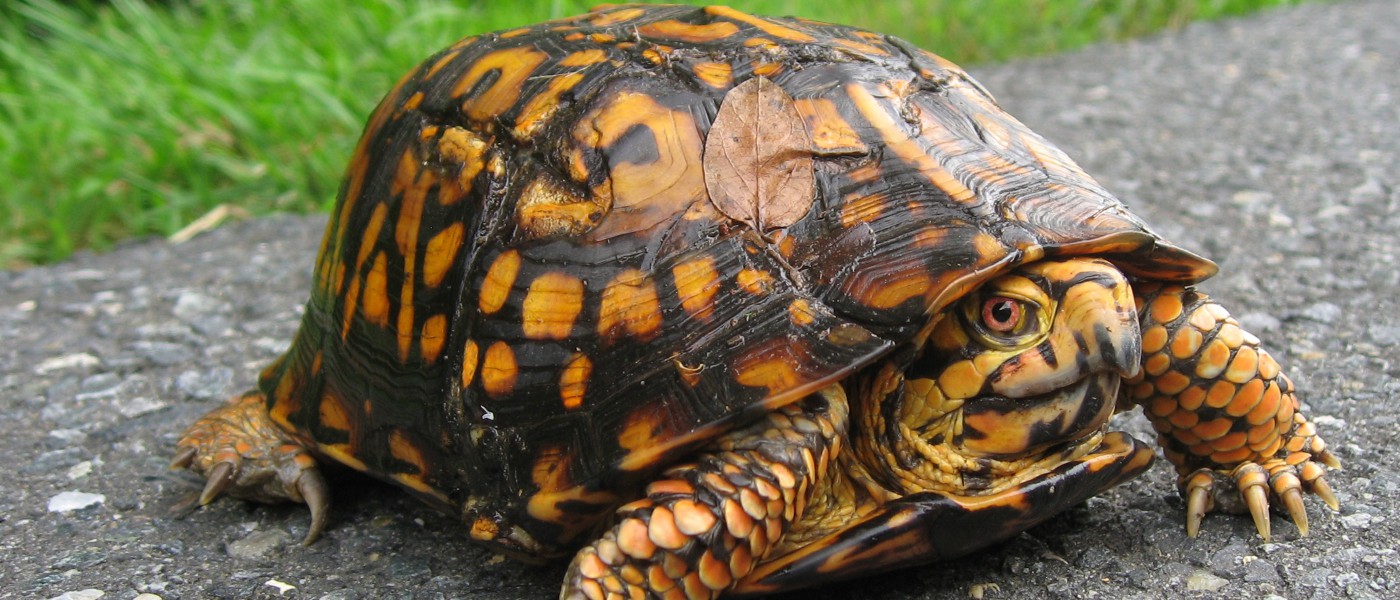
I should have known from the start that I was in for a close encounter of the reptilian kind. From my first spring on Shelter Island, a sleepy little place sandwiched between the north and south forks of eastern Long Island, homemade Box Turtle X'ing signs sprouted mysteriously along roadsides as soon as the shadbush began to bloom. Over the next decade I'd occasionally see one of the peaceful little beasts chomping on a plump mushroom while plodding deliberately across my moss lawn. I even collected their boxlike shells from my woods, each one a unique pattern of yellow to orange splotches, blotches, streaks, and dabs on a dark background. Back then, box turtles seemed cute, but they weren't as beguiling as the monarchs, swallowtails, and other butterflies I spent so much time and money luring to my garden.
Then, one morning early last summer, a box turtle lumbered stoically through my butterfly meadow, trudged across my mangy back lawn, made his way to the middle of my patio, then stopped dead in his tracks. He extended his long reptilian neck and proceeded to look dolefully from side to side. After what seemed like ages, he continued across the patio to a white pine along the edge of the woods and disappeared in the pine needle duff.
Suddenly it dawned on me. He was looking for my muck garden! A few weeks earlier, to make more room for sunbathing and barbecues, I'd expanded my patio, in the process demolishing the tiny bog I'd created between the house and patio to attract still more butterflies with moisture-loving wildflowers.
Since that day, in hopes of making amends, I've made it my business to find out what box turtles like to eat, where they like to siesta on a hot summer day, and how these creatures, among the longest-lived vertebrates, make it through the winter. I've done my penance in the library, reading scientific tomes on box turtle fecal contents and other engrossing subjects. In the process, I've learned not only that we gardeners can help ease the plight of the placid, plodding reptiles, which are gradually disappearing from landscapes across eastern North America, but also that box turtles have a lot to offer us in return—beyond the usual bromides about the virtues of patience and perseverance.
Sticky Heels
So many people have had an encounter with an eastern box turtle that it's often known as the common box turtle. Meeting up with one almost always leaves a good impression. They're appealing animals with their brightly patterned, lumpy shells, stumpy legs, short little tails, and animated facial features. They're easy to catch and hold and, unlike so many other reptiles, they rarely bite. Their lovable slow, lumbering gait led the Delaware Indians to call them "sticky heels." Their ability to close up tightly in their shells is pretty nifty too.
Four box turtle species are native to North America. The eastern box turtle, Florida box turtle, Gulf Coast box turtle, and three-toed box turtle are all subspecies of Terrapene carolina. The ornate box turtle, Terrapene ornata, is primarily a turtle of the prairies and the Southwest; the spotted box turtle, Terrapene nelsoni, lives in the Sonoran Desert; and the Coahuilan box turtle, Terrapene coahuila, is native to a single valley in Mexico's Chihuahuan Desert. The only truly aquatic species is the Coahuilan box turtle; the others are terrestrial but enjoy a refreshing dip in a pond every once in a while.
Eastern box turtles are found throughout much of eastern North America. Their version of turtle heaven includes not only shady woods with a thick layer of leaf litter and downed branches to hang out in but also ample sources of water and sunny areas for basking.
Box turtles dig out of their excavated overwintering sites in April and are active until October. In spring and summer they forage, gain weight and grow, bump (literally) into mates, and lay eggs. They spend the night concealed in a "form," a shallow depression in soil or leaf litter. They love leaf litter and not only sleep and hibernate in the stuff but also tunnel through it, blazing trails along the forest floor.
Herpetologists seem to have a thing about carving their initials in box turtle shells. One lucky creature from Rhode Island with the dates 1844 and 1860 and two sets of initials scored into its plastron, or lower shell, was thought to have been at least 138 years old. Although eggs and hatchlings often get picked off by raccoons and foxes, any box turtle that survives the juvenile stages has a good shot at living as long as a human—assuming it doesn't get creamed by a car while crossing a road or mangled by a mower. More on that in a minute.
Scientists who have closely examined the digestive-tract contents of eastern box turtles claim they come about as close as it gets to the classic definition of an omnivore—they'll eat just about anything that crosses their path. Two researchers from Southern Illinois University found the most important box turtle food groups to be (by volume) unidentified plant material (34.2%) and seeds (17.4%), as well as—gardeners take note—insects (19.6%) and snails and slugs (10.6%). (Another scientist discovered that snails and slugs comprised 52% of the diet of ten eastern box turtles in Kentucky. That's my kind of critter!) At certain times of year, mushrooms are a tasty Terrapene treat.
All this leads me to conclude that my friendly box turtle came to my muck garden often to dine on juicy slugs, maybe even to cool his sticky heels on sultry summer days. And he truly must have been perplexed (in a reptilian sort of way) by the fact that one of his favorite hangouts had disappeared—scientists believe box turtles have good memories for choice feeding and resting spots. At least one group of researchers found entire turtle congregations returning regularly to feast at favored fruiting plants.
Although much is known about seed dispersal by birds and mammals, little is known about saurochory, the dispersal of seeds by reptiles. But C. Kenneth Dodd Jr., who has written the book about North American box turtles, maintains that "eastern box turtles are also important agents of seed dispersal," moving seeds throughout the forest. What's more, studies have demonstrated that passage through a box turtle's gut increases germination rates for some seeds, including mayapple (Podophyllum peltatum), black cherry (Prunus serotina), summer grape (Vitis aestivalis), pokeweed (Phytolacca americana), and jack-in-the-pulpit (Arisaema triphyllum). Black huckleberry (Gaylussacia baccata), elderberry (Sambucus canadensis), mulberries (Morus species), blackberries (Rubus species), American persimmon (Diospyros virginiana), and frost grape (Vitis vulpina) are other favorite fleshy fruits.
Gardening for Box Turtles
Like other wild animals, box turtles increasingly find themselves marooned in a sea of suburbs. Populations in fragmented habitats may be composed mostly of seniors or nonreproducing adults on a long, slow slide toward extinction; if there aren't enough turtles in the immediate vicinity, they may not meet frequently enough to mate. Habitat loss and fragmentation aren't the only threats. Although they're protected by state and international regulations, box turtles are often stolen from the wild for sale in the pet trade. Road kills and mower mortality reduce their numbers even more.
Fortunately, we gardeners can play a role in nurturing these plucky reptiles—and get rid of some slugs as part of the bargain. Here are a few actions to consider:
- Invite box turtles into your garden by planting their favorite fruits (see above). In sunny areas, encourage dense clusters of brambles, and let the ripened berries fall. Choose species that fruit at different times during the season. (But be aware that these beasts have a well-known penchant for raiding vegetable gardens, especially for cantaloupes and tomatoes, so erect a little box turtle barrier.)
- Leave large, continuous areas of natural leaf litter mulch beneath the trees on your property, where the animals can remain camouflaged and forage for prey. Build brush piles over soft, loose soil by layering branches and leaf litter, where they can spend the night or overwinter.
- Any moist place, whether swamp, damp forest depression, or simple water garden, will help turtles survive the hottest parts of the day.
- Provide a large, and preferably isolated, clearing. Box turtles use such areas for traveling, mating, and basking. They also lay their eggs in sunny spots.
- Site all turtle habitat as far as possible from deadly roadways.
- Read your mower manual: Before mowing, walk the area in search of flying objects. Turtles are potential flying objects. Mow on a dry day, at midday, when turtles are less likely to be out and about. Better yet, mow in winter when they're tucked in safely underground.